





Preclinical results for an anticancer drug developed under the auspices of the NCI RAS Initiative were recently reported in Cancer Discovery.
The drug, BBO-11818, hindered tumor growth or shrank tumors in laboratory and mouse models of non-small cell lung cancer, pancreatic ductal adenocarcinoma, and colorectal cancer.
BBO-11818 is a pan-KRAS inhibitor—a treatment designed to block multiple mutant forms of the KRAS protein. The preclinical data indicate it’s highly specific to mutated KRAS. That suggests it spares healthy cells and may bear tolerable side effects.
BridgeBio Oncology Therapeutics, Frederick National Laboratory for Cancer Research, and Lawrence Livermore National Laboratory, collaborated on the study.
Clinical trials still need to determine whether BBO-11818 is effective in humans. A Phase I trial testing safety in people with lung, colorectal, and pancreatic cancers is underway.
Molecular Handcuffs
Mutated KRAS proteins exist in an estimated 11–20% of all human cancers, including nearly all pancreatic cancers. Certain mutations keep KRAS in an overactive state, allowing it to continuously activate signaling proteins that drive uncontrolled cell growth.
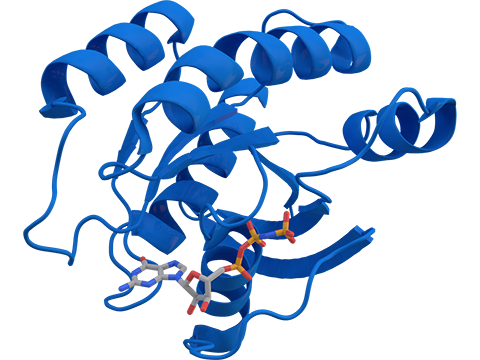
BBO-11818 binds to mutant KRAS and locks it into a shape that cannot interact with these signaling proteins, like molecular handcuffs. This disrupts the signals KRAS-driven cancer cells need to grow and divide, reducing their ability to survive.
As a pan-KRAS inhibitor, BBO-11818 inhibits multiple KRAS mutants in both “on” (active) and “off” (inactive) forms. There are currently no pan-KRAS inhibitors with FDA approval.
“What differentiates it from what’s on the market right now is it’s dual, so, it targets both the ‘on’ and ‘off’ forms of KRAS,” said Anna Maciag, Ph.D., an author on the study and the head of the RAS Initiative’s Drug Screening and Preclinical Research group at Frederick National Laboratory for Cancer Research.
Treatments targeting both “on” and “off” mutated KRAS can affect a spectrum of cancers. Drugs that target only one state miss the population of malignant cells in the other state, allowing the tumor to eventually rebound.
BBO-11818 Broadly Effective
In mouse models, low and moderate doses of BBO-11818 slowed or, in some cases, reversed tumors’ growth. High doses shrank pancreatic and colon tumors and almost completely halted lung tumors.
In all cases, treated mice had only minor fluctuations in body weight, which indicates they tolerated the treatment well.
The team noted BBO-11818 is particularly potent against the KRAS G12D mutant in cell cultures. G12D is the most common KRAS mutation in no fewer than eight cancers ranging from brain to bladder, according to analyses of the Pan-Cancer Atlas.
The drug also inhibits cancer cells with the G12V, G12C, G12A, G12S, and G13D mutations. Of note, G12A and G12S are rarer and have received less attention as targets for drug development. BBO-11818 may therefore help fill a therapeutic gap for cancers with these mutations.
However, BBO-11818 is markedly less effective against G12R and all Q61-series mutations, the team reported. G12R is the third most common KRAS mutation in pancreatic cancer. Mutations in Q61 are prevalent in papillary thyroid cancers.
Potent When Combined
As part of the study, the team tested BBO-11818’s efficacy in mouse models when combined with other cancer treatments.
Paired with a PD-1 inhibitor, a compound that makes it easier for the immune system to attack cancer cells, BBO-11818 significantly extended survival of mice with colon cancer tumors compared with either treatment alone.
BBO-11818 and BBO-10203, an experimental RAS Initiative drug that disrupts a protein that cooperates with KRAS, together shrank pancreatic and lung cancer tumors more potently than either drug alone.
Likewise, BBO paired with cetuximab, an antibody that disrupts a different set of mechanisms, shrank colorectal cancer tumors more significantly than either alone.
Clinical Trial Ongoing
The ongoing Phase I study will clarify whether BBO-11818 is safe in humans. Future trials will investigate BBO-11818’s effectiveness.
The RAS Initiative continues to study BBO-11818, in addition to BBO-10203 and another compound that has entered clinical trials, BBO-8520.
“We are very proud of what we have achieved,” Maciag said of the team. “These people are very seasoned drug developers.”
Samuel Lopez leads the editorial team in Scientific Publications, Graphics & Media (SPGM). He writes for newsletters; informally serves as an institutional historian; and edits scientific manuscripts, corporate documents, and sundry other written media. SPGM is the creative services department and hub for editing, illustration, graphic design, formatting, and multimedia.