





Antibody-drug conjugate. This complex vocabulary masks a straightforward idea: Tether a cancer-killing drug to an antibody, then administer it to a cancer patient for a two-in-one strike on their tumors.
Unfortunately, it’s rarely so simple. While some ADCs (as they’re called for short) work well, many cause severe side effects or have proven ineffective.
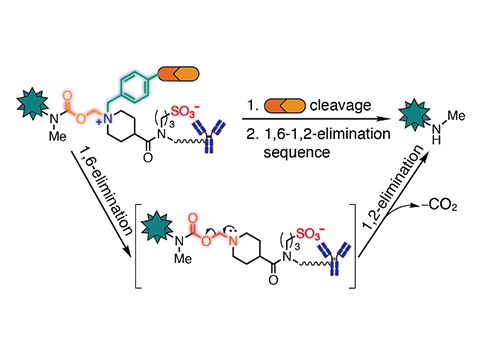
Martin Schnermann, Ph.D., and his team in the Chemical Biology Laboratory are part of a field of chemists trying to improve ADCs. To do so, they’ve focused on neither antibodies nor drugs but rather the linkers, the molecules that tether the two together.
They and their collaborators recently achieved encouraging success. Using a custom linker called BAC, they developed a new ADC that kills head and neck squamous cell carcinoma (HNSCC) in cellular and mouse models—with fewer side effects.
The findings are available as a preprint on Research Square. (This means independent scientists haven’t yet reviewed the data on behalf of a scientific publisher.)
The new ADC, called PAC-XL, is far from being approved for human use. However, the findings add to growing evidence that customized linkers can expand the repertoire of usable antibodies and drugs while making ADCs more stable, effective, and tolerable.
Conjugate More Effective, Less Harmful Than Other Approaches Tested
PAC-XL uses BAC to tether cetuximab, an antibody targeting a common mutation in HNSCC, to BGT226, a drug that kills cells with another common mutation in HNSCC. Schnermann’s lab previously created BAC and validated its chemistry.
“You can’t modify the drug, because the drug is the drug, but you could modify the linker. And that’s what that … BAC linker helps us to do,” said Schnermann, senior investigator and a senior author on the study.
PAC-XL remained stable in human cells and mouse models of HNSCC days after treatment. In laboratory tests, it targeted and killed HNSCC cells more potently than cetuximab alone. (BGT226 alone wasn’t tested in the cell model.)
In the mice with HNSCC tumors, PAC-XL killed cancer cells and shrank the tumors better than cetuximab alone, BGT226 alone, and another standard drug. It also caused fewer side effects.
This is encouraging, as BGT226 “failed with all the other linkers we tried,” Schnermann said.
Other groups’ past studies showed BGT226 causes severe side effects in humans. The current study suggests BAC may change that, though PAC-XL still must undergo clinical safety testing to confirm it.
Schnermann’s team performed the study in collaboration with the laboratory of John Brognard, Ph.D., at State University of New York, formerly of NCI Frederick, and scientists at the NCI Laboratory of Cell and Developmental Signaling and NJ Bio, Inc.
The Animal Research Technical Support group at Frederick National Laboratory for Cancer Research oversaw the blood collections and glucose monitoring for side effects in mouse models.
“They’re amazing, and the work they do really enables the science we do,” Schnermann said.
The mouse models were crucial for understanding PAC-XL’s safety, and their results inform future efforts for both patients and models.
“We want to help the patient and not cause them a lot of side effects.” said Simone Difilippantonio, director of Animal Research Technical Support.
Likewise, “we do not want to just put compounds in the animals and cause them negative impact,” she said.
BAC Built for Stability
BAC was engineered to overcome traditional challenges in linker chemistry.
“You would assume it’s simple, right? ‘You just put the linker on the drug and attach it,’ but in practice, it’s really not,” Schnermann said.
An ADC’s stability hinges on how well the linker acts as a tether. If the linker is too fragile or too rigid, the drug never enters the tumor. The linker’s polarity also dictates whether it can bind a given drug.
BAC is a zwitterion, a class of neutral-polarity molecules used in some nanomedicines. Zwitterions are a sort of “invisibility cloak” in the bloodstream, where molecules with strong polarity are easily dissolved but neutral-polarity molecules are more stable.
Zwitterionic linkers like BAC therefore have a smaller chance of being broken in circulation—yet break at the right time, once they touch a cell’s membrane. They can stably grasp the drug until the ADC reaches the target tumor.
Xiaoyi Li, Ph.D., a postdoctoral fellow in Schnermann’s lab, solved the chemistry to get BAC to work in PAC-XL.
As part of testing, imaging studies replaced BGT226 with a fluorescent probe to ascertain whether BAC let PAC-XL efficiently deliver its drug payload. When examined, fluorescent signals came from inside the tumors, indicating the probes—and, by extension, BGT226—entered the HNSCC cells as intended.
Schnermann’s team first began developing zwitterionic linkers as tools for fluorescence imaging, aiming to get the probes to target cells more accurately. The success of those studies spurred the group’s efforts to use related chemistry for ADCs.
They plan to continue developing new linkers for ADCs and fluorescence imaging, Schnermann said.
Samuel Lopez leads the editorial team in Scientific Publications, Graphics & Media (SPGM). He writes for newsletters; informally serves as an institutional historian; and edits scientific manuscripts, corporate documents, and sundry other written media. SPGM is the creative services department and hub for editing, illustration, graphic design, formatting, and multimedia.