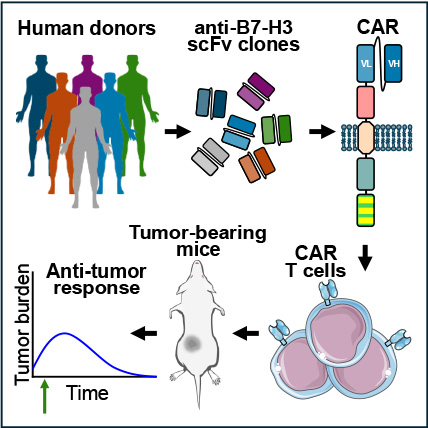



NCI Frederick researchers and colleagues are improving therapies that modify and equip a patient’s own immune cells to target their solid tumors. Their modification, while still at an early stage of development, can potentially minimize the risk of armed cells being therapeutically rejected by the patient’s immune system. Their paper was published in Cell Reports Medicine on April 29, 2026.
How Can CAR T Cell Treatments Be Improved?
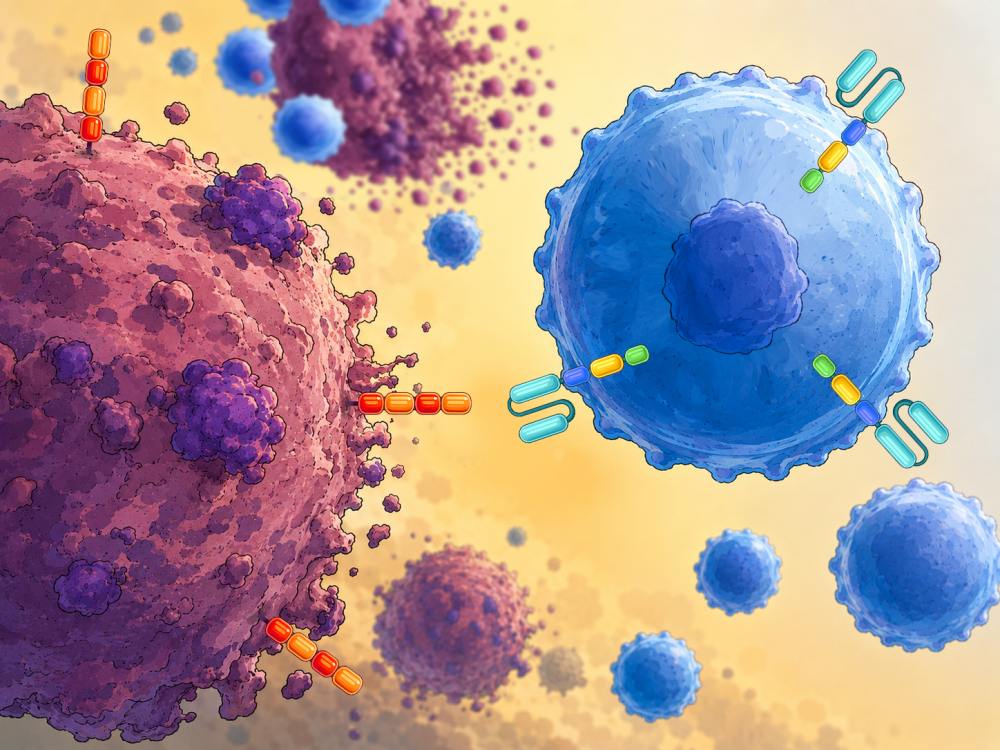
Solid tumors are notoriously difficult to treat. CAR T therapy, in which a patient’s own T cells (a type of white blood cells) are withdrawn, modified, and reinfused, enables immune cells to more effectively target tumor cells that overexpress specific proteins on their cell surface.
To engineer CAR T cells to target a specific protein, a binder—usually an antibody fragment—that can recognize the tumor target (an antibody) is fused to the CAR and expressed on the T cell surface. The team previously identified B7-H3 as a near-ideal target, overexpressed in tumor cells and their surrounding cells in most cancer types.
While targeting B7-H3 with CAR T cells could be an effective way to destroy these tumors and the surrounding cells that support them, the targeting components currently being used in clinical trials to recognize B7-H3 are based on antibodies originally developed in mice, which may not be ideal for use in humans.
Though they can be effective, there is a risk the immune system might recognize them as foreign and reject them, said St. Croix, a senior scientist in the Mouse Cancer Genetics Program and head of the Tumor Angiogenesis Unit.
What Did the Study Do to Improve this Treatment?
Yang Feng, Ph.D., a senior biologist in St. Croix’s laboratory, screened antibody phage display libraries and identified human antibody fragments that bound to B7-H3 as well as or better than the mouse binders already in use.
To test these binders, Pradip Bajgain, Ph.D., a postdoc on St. Croix’s team with expertise in T cell engineering, created CARs with the human binders. Then, he tested them, first against tumor cells in culture, and then using preclinical mouse models of pancreatic cancer, neuroblastoma, and glioblastoma—aggressive cancers that have limited treatment options and don’t respond well to available treatments.
CAR T cells incorporating a specific binder called Y111 showed potent anti-tumor activity and outperformed established CARs that used the murine binders currently in clinical trials. In fact, in one study using pancreatic tumors, Y111 CAR engineered T cells remained functional and produced long-term tumor remissions, extending mouse survival for nearly 15 months after a single-dose treatment.
“Observations like this are rare in the field, and a first one for me, even though I have worked in [the] CAR T cell space for nearly 15 years,” said Bajgain.
Collaborators were able to replicate the findings.
“That others can readily reproduce our findings helps give us confidence that we’re on the right track,” said St. Croix.
What Are the Implications?
Even so, there’s still work to do. For one, the human Y111 binder used in the study has a human target bias, meaning it binds better to the B7-H3 target in humans than in mice. This means it may not fully predict how the treatment behaves in people and could, in theory, cause side effects in healthy tissues.
That said, early clinical trials using B7-H3–targeted CAR T cells have so far shown manageable safety profiles. Although, these studies rely on mouse models, which have important limitations – particularly their weakened immune systems – so results may not fully reflect what happens in patients.
Eventually, human trials will be needed to determine if the therapeutic is effective.
The team also doesn’t fully understand why this binder outperformed others. While they have uncovered some important leads, further studies are needed to explore how and why this is working.
While the team is hopeful that their Y111 binder will show better activity than current B7-H3 CARs in clinical trials, the improvement in CAR T activity from this enhancement alone is unlikely to be enough to eradicate all B7-H3–positive cancers.
As St. Croix notes, “There are many other studies ongoing in parallel that are designed to help improve the activity of CARs even further. It might ultimately require putting our binder together with some other modification to make the CAR T [therapy] more effective.”
Ultimately, this study is one step toward improved treatments that may one day be used against these hard-to-treat cancers.
Though St. Croix remains “cautiously optimistic” about the potential of this therapy, he knows it’s just a step on the path to a truly effective treatment.
Karolina Wilk is a technical editor in SPGM, where she writes for NCI Frederick and Frederick National Laboratory’s news outlets and edits scientific manuscripts, corporate documentation, and other writing. SPGM is the creative services department and hub for editing, illustration, graphic design, formatting, and multimedia training and support.