





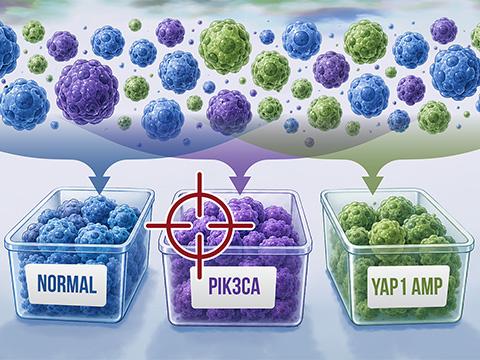
A team of scientists from NCI, Frederick National Laboratory for Cancer Research, and industry has created a new basis for classifying cervical cancers based on their genetic mutations. With it, they’ve proposed and tested a potent approach for treating one subtype of cervical tumors.
By pinpointing differences between subtypes of the same cancer, scientists can develop better treatments that are more tailored and targeted to distinct mutations.
To date, cervical tumors largely haven’t been treated in this way, despite there being more than 500,000 new cases worldwide each year.
“Even today in the U.S., we take all cervical cancer patients, put them in one group, and essentially treat them the same. … So, we’ve been trying to [address] that,” said Michael Dean, Ph.D., senior author on the study and senior investigator in the NCI Laboratory of Translational Genomics.
The study appears in Neoplasia.
Three Subtypes Identified
The study combined samples from government and industry repositories. In total, the team analyzed over 3,000 cervical tumors and 22 cell line models of cervical cancer. This cohort was big enough to identify valid subtypes.
The team used the two most altered genes in cancers, PIK3CA and YAP1, as the benchmark for classification.
After sequencing the tumors’ genes, the team categorized the samples into three cervical cancer subtypes: those with normal PIK3CA and normal YAP1, those with mutated PIK3CA and normal YAP1, and those with higher-than-normal (amplified) YAP1.
How Treatment Worked
With this information, the team investigated a targeted treatment against the subtype with mutated PIK3CA.
There are already FDA-approved drugs to treat breast cancer with mutated PIK3CA. There are none for cervical cancer, but existing, approved drugs are known to be safe and can sometimes be repurposed to treat different cancers, which saves time, Dean said.
The team administered two such drugs, alpelisib and inavolisib, individually to laboratory models of cervical cancer. Even at low doses, each significantly hindered the tumors’ growth and proliferation.
Because many cancers can overcome PIK3CA inhibition, the team also tested a combination treatment to attack the cancer through secondary means.
They paired alpelisib with targeted T cells, a type of immune system cell, developed by NexImmune. Together, the two more potently reduced cervical cancer growth than either of them alone.
Further investigation revealed that alpelisib restricts PD-L1, a protein that suppresses immune cells’ activation and is elevated in cervical cancer. This amplifies the T cells’ ability to kill the tumor cells.
“There could be a cooperativity between the PIK3CA inhibitors and immune therapy, which we think is exciting,” Dean said.
Past Work Spurred Discovery
The study emerged from NCI and Frederick National Laboratory for Cancer Research’s past work that identified PIK3CA mutations as the most frequent mutation in cervical cancer, according to Dean and Hong Lou, Ph.D., lead author on the current study and scientist in the Cancer Genomics Research Laboratory.
“We found that this mutation dramatically increases the PD-L1 that is related to immunotherapy. That’s why we continued to try to test, then finally got good results” in the current study, Lou said.
Since alpelisib is already approved for clinical use, Dean has advocated for a clinical trial to test these approaches in people with cervical cancer harboring mutated PIK3CA.
Samuel Lopez leads the editorial team in Scientific Publications, Graphics & Media (SPGM). He writes for newsletters; informally serves as an institutional historian; and edits scientific manuscripts, corporate documents, and sundry other written media. SPGM is the creative services department and hub for editing, illustration, graphic design, formatting, and multimedia.