





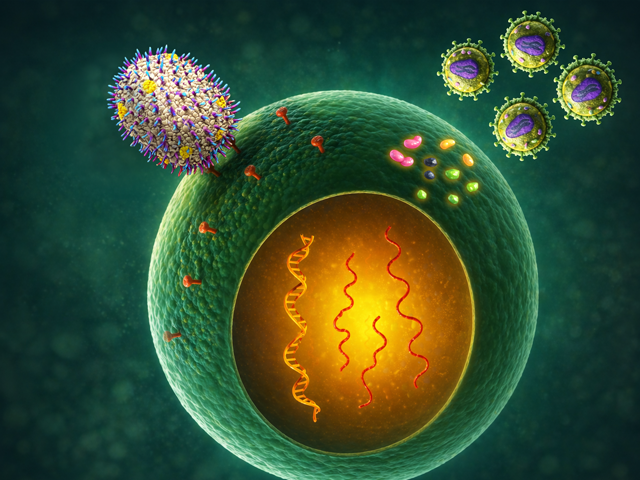
Academic researchers, along with scientists at NCI Frederick, are repurposing a harmless bacterial virus to reactivate dormant HIV-infected T cells for destruction. Their proof-of-concept study, published in iScience, is an early step in testing this platform.
T cells—a type of white blood cell—that can be HIV-infected and dormant pose a major hurdle to curing people with HIV, as they persist and proliferate but may go undetected by the immune system. Reactivating them reveals their presence so they can be eliminated, by either the immune system or antiretroviral drugs, as part of a “shock-and-kill” strategy.
Bacterial Virus as a Treatment
Bacteriophage T4 is the basis for the team’s approach. In nature, bacteriophages are viruses that infect bacteria, not humans. Some are highly customizable in the lab, making them suitable for developing new treatments to many human diseases.
“It is a platform technology that can be adapted to HIV cure, gene therapies, and cancer therapies,” said Venigalla Rao, Ph.D., senior author on the study and the founding director of the Bacteriophage Medical Research Center at The Catholic University of America.
Rao’s laboratory modified two nonessential proteins that speckle the surface of T4. They then attached around 150 copies of a molecule engineered to target CD4 T cells, a key type of cell HIV infects, similar to HIV.
“The T4 shell can be easily modulated to be taken up into cells by ‘decorating’ the surface with molecules of interest,” said Frank Maldarelli, M.D., Ph.D., collaborating senior author and a senior investigator in the HIV Dynamics and Replication Program at NCI Frederick.
How Does It Work?
The team administered modified T4 to J-Lat cells, a lab model of dormant HIV-infected CD4 T cells. They also studied its effects on dormant infected CD4 T cells in blood samples from people with HIV. It was supposed to reactivate (“shock”) the infected cells, triggering them to begin producing HIV.
Modified T4 extensively reactivated the J-Lat cells and the T cells from human blood. Among the J-Lat cells, it increased HIV activity up to 17.4 times more than the baseline. In the blood samples, staining revealed T4 attached to CD4 T cells with high affinity, mimicking the HIV virion, a sign that it potently swarms its target.
The team also found that modified T4 entered CD4 T cells, like HIV virions do, which means it could be used to deliver a therapeutic payload. In the future, it may be a vehicle for specific, directed treatments, Rao said.
Importantly, modified T4 didn’t trigger extensive inflammation or severe, overreactive responses from other immune cells in the blood samples. This means it may cause mild or no reactions in humans, thereby avoiding an issue with many shock-and-kill therapies.
More Studies Needed, More Work Planned
This work is preliminary and requires further studies in T cells from people taking antiretroviral drugs, appropriate preclinical models, and—eventually—people living with HIV. Rao and colleague Himanshu Batra, Ph.D., have patented the platform, and the team plans to continue investigating.
“Bacteriophage-mediated cell therapies are a new and emerging frontier that would not only complement the existing viral vector models but also have the potential to transform future biomedicine,” Rao said.
Samuel Lopez leads the editorial team in Scientific Publications, Graphics & Media (SPGM). He writes for newsletters; informally serves as an institutional historian; and edits scientific manuscripts, corporate documents, and sundry other written media. SPGM is the creative services department and hub for editing, illustration, graphic design, formatting, and multimedia.