





Scientists have found a powerful, precise chemical “off switch” for an enzyme involved in neurodegenerative diseases and cancers.
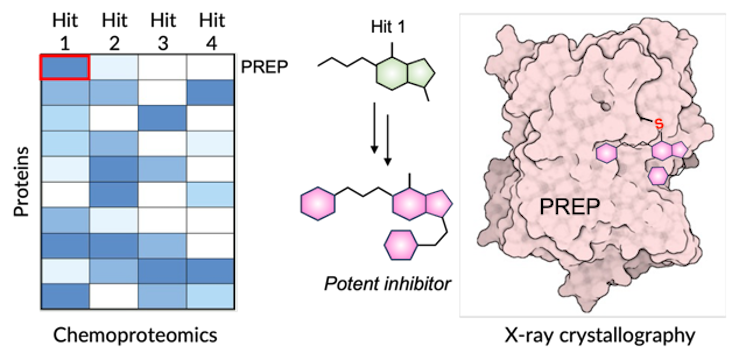
A team of researchers from NCI’s Center for Cancer Research (CCR) and the Frederick National Laboratory for Cancer Research, in a paper published in the Journal of Medicinal Chemistry, identified a potent and specific inhibitor for the enzyme prolyl endopeptidase (PREP).
PREP is essentially a pair of molecular scissors that cuts apart the building blocks for proteins at specific points. This activity is believed to contribute to Parkinson’s disease and dementia and, more recently, has been identified as having a role in several cancer types.
Being able to inhibit PREP will allow scientists to carry out studies to further understand its role in these and other diseases. This inhibitor can be used as an effective tool for further research to understand and eventually know how to treat diseases associated with PREP functions.
Building a Map of the Enzyme’s Structure
Euna Yoo, Ph.D., co-senior author on the study and head of the Chemical Immunology Section in CCR’s Chemical Biology Laboratory, discovered some targets that would affect PREP in a library of potential inhibitors. Yoo’s team then partnered with the CCR Center for Structural Biology to conduct X-ray crystallography on the enzyme bound to the identified inhibitors.
X-ray crystallography works by creating crystals of the molecules in question and shining X-rays through them. By analyzing the reflective patterns using computational methods, researchers can learn about the molecule’s shape, like looking at light that shines through a stained-glass window to indirectly ‘see’ the design.
Monteiro calls the technique “the bedrock of structurally guided drug design,” which they used to collect atomic data that enabled them to essentially build a map of PREP’s structure as it was bound to the inhibitors.
With these, they were able to find a way to understand how the inhibitors they’d identified fit into PREP’s structure and identify ways they could improve the molecular interactions and thus the inhibitors’ potency.
“By understanding these interactions of high-resolution structure, we can drive the [design of these chemical tools],” said Monteiro.
Yoo was thankful that it was so easy to establish this useful collaboration. “I think the initiation and continuation of this project … are possible because of this unique environment that we are in,” said Yoo, crediting the fact that so many specialists are available under one roof at CCR.
“I don’t think that drug discovery is something that you do alone,” said Monteiro. She added, “[Our two areas] work very well, synergistically, to not just generate these initial leads, but actually have them translate [eventually to the clinic].”
Dynamic Modeling to Predict Movement and Optimize Inhibitor Structure
The data from Monteiro’s crystal structures created “static snapshots,” said Yoo, which gave them a lot of information and helped them select an inhibitor to work with. But PREP is a dynamic molecule: in the body, it changes shape based on different biological states.
To overcome this limitation of their understanding, Yoo’s postbaccalaureate fellow, Joshua Pandian, constructed computational models and used molecular dynamics simulations to predict PREP’s dynamic movements and how inhibitor binding influences its structure.
They could then chemically modify the inhibitor to better fit the structure based on what the modeling showed. The models also revealed that the selected inhibitor changed the shape of a flexible part and stabilized a particular form of PREP, hinting at why it may work.
Ultimately, the new, modified inhibitor was highly effective even at low concentrations and highly selective, targeting only PREP and none of the similarly structured enzymes.
Yoo’s team plans to use these novel inhibitors in further research studies to learn more about diverse functions of PREP.
“The next step for this project is to apply chemical biology approaches to better understand the function of this enzyme in cancer,” said Yoo.
Karolina Wilk is a technical editor in SPGM, where she writes for NCI Frederick and Frederick National Laboratory’s news outlets and edits scientific manuscripts, corporate documentation, and other writing. SPGM is the creative services department and hub for editing, illustration, graphic design, formatting, and multimedia training and support.