





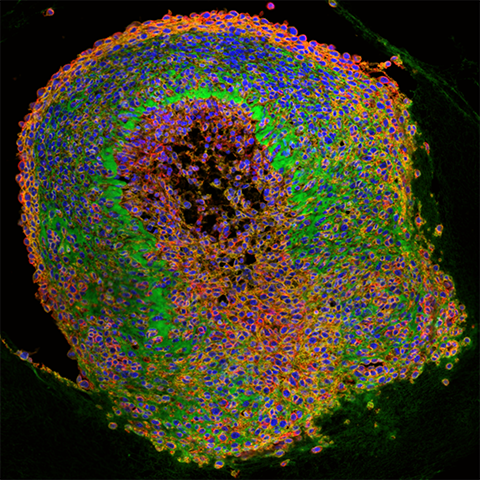
Bioengineers at NCI Frederick and Frederick National Laboratory for Cancer Research, with external collaborators, have devised new types of 3D miniature tissues that assemble themselves and better reflect the composition of tumors in the body compared to existing models.
The team aimed to complement organoids, a class of expensive, human-like models. Their creation, dubbed “MatriSpheres,” offers an inexpensive, middle-ground platform but, unexpectedly, also includes features that are unique from organoids.
Like some of their modeling cousins, MatriSpheres are microscopic balls of cancer cells. But unlike some of these other models, they’re also interwoven with structural proteins that are important for supporting tumors’ progression, resembling the characteristics of human tumors.
In another unique deviation from other models, MatriSpheres spontaneously coalesce and self-assemble with minimal manipulation by scientists, under the right conditions.
MatriSpheres are a potential tool for studying cancer biology and screening therapies to get results with high relevance to patients’ health, another step toward creating laboratory models with greater resemblance to human disease. They also align with the National Institutes of Health’s goal of prioritizing human research and reducing the use of animals in research, announced earlier this year.
A study detailing MatriSpheres appears in Cancer Research, along with a commentary that discusses the findings.
The data do come with a word of caution, however. MatriSpheres are in development and haven’t yet been used to study cancer treatments. So far, scientists have confirmed they assemble correctly and model cancer in a relevant way. Future studies will do more.
Making the Matrix
Within the body, tumors dwell in their own miniature environments of surrounding tissue, which influences their behavior, biology, and susceptibility to treatment. Laboratory models of cancer vary in how much they incorporate this microenvironment. Those that do tend to be more useful for understanding the disease in living organisms than those that don’t.
MatriSpheres tap into this by combining the tumor cells and the extracellular matrix (ECM), a collection of proteins, fibrous molecules, carbohydrates, and other microscopic components that partially comprise microenvironments.
The ECM is “nature’s scaffold for our tissues,” said Matthew Wolf, Ph.D., senior author on the study and a Stadtman investigator in the NCI Frederick Cancer Innovation Laboratory. It’s a key component of the support network that helps all tissues—including cancer cells—thrive.
Although scientists can already use commercial products, like gels and collagen solutions, to create cancer models that incorporate an ECM, the team wondered whether a different approach could improve upon what was available.
“We wanted to create more accurate models of that ECM environment using our tissue-derived ECM,” Wolf said.
Instead of using gels, they put small samples of pig intestine through a chemical process that cleaned them and stripped away the intestinal cells. The leftover result was the components of the ECM.
This mixture, they found, better resembled the broad composition of colorectal tumor ECM than two common products do. It contained more of the tumor ECM proteins than the commercial materials, a diversity that more closely aligns with the ECM proteins found in a patient’s body.
Self-Assembling Building Blocks
The team’s ECM components drive MatriSphere formation. The liquified ECM can be added to a confined, low-adhesion environment containing select cancer cells. Generally, cells are predisposed to interact with ECM, and with nothing else to stick to, they begin adhering.
Over a few days, the cells and ECM components build themselves into MatriSpheres. Cells and ECM fragments latch onto each other, while cells also adhere to other cells that’ve already engaged with the ECM. Like microscopic puzzle pieces, they fit together to form the 3D model.
In contrast, many existing models depend on the addition of certain helper cells, such as fibroblasts, that have a role in producing the ECM. Often, these alternative culture systems require complex media recipes to stimulate cell growth and achieve the desired result, a costly process that can take weeks.
“[Our] model is unique because we don’t necessarily need to add fibroblasts or supplement with growth factors. This allows us to control the environmental variables by selecting the desired matrix composition that we mix with our cancer cells,” said Michael Buckenmeyer, Ph.D., lead author on the study and a postdoctoral fellow in the Cancer Innovation Laboratory.
So far, the team has published results for MatriSphere assembly in two types of mouse cancer cells and one human colorectal cancer cell line. They look forward to working with the scientific community to further expand the research and—eventually—use MatriSpheres to test cancer treatments.
“MatriSpheres provide an exciting tool for cancer research, and we are eager to expand their use in drug screening and discovery efforts to drive the next generation of cancer therapies,” Buckenmeyer said.
Samuel Lopez leads the editorial team in Scientific Publications, Graphics & Media (SPGM). He writes for newsletters; informally serves as an institutional historian; and edits scientific manuscripts, corporate documents, and sundry other written media. SPGM is the creative services department and hub for editing, illustration, graphic design, formatting, and multimedia.