




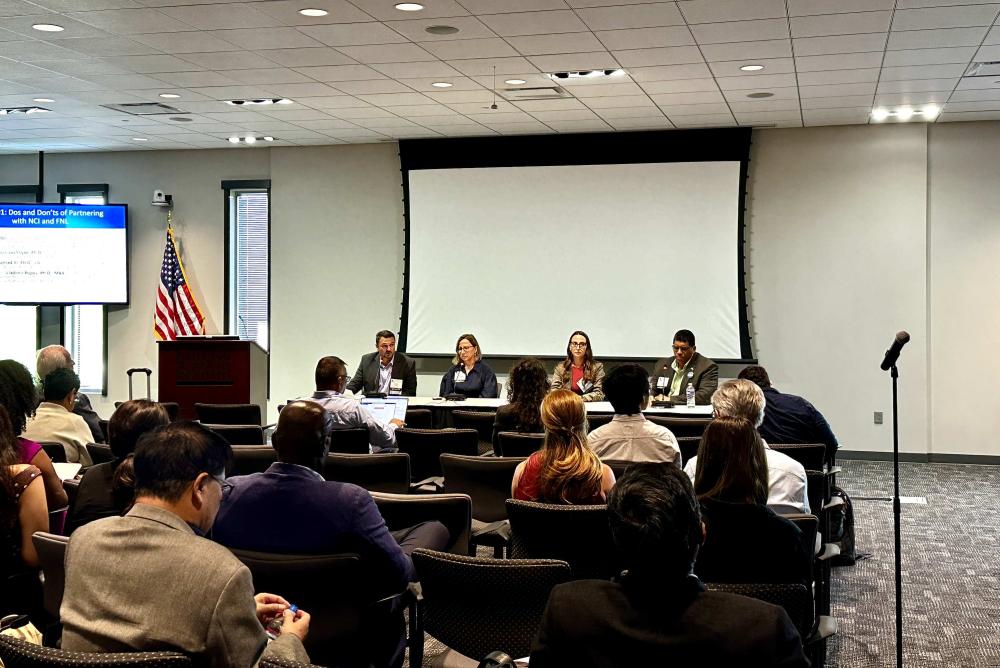
More than 150 members of the local biotechnology community attended the 2026 Technology Showcase, hosted by the Frederick National Laboratory for Cancer Research (FNLCR) and National Cancer Institute (NCI).
It was a packed event, with a keynote, a patient advocate talk, two panels, four technology presentations, four funder pitches and two programmatic presentations—all in just five hours.
To set the tone, Jeff Allen, Ph.D., president and CEO of Friends of Cancer Research, gave a keynote that emphasized the importance of collaboration, including public–private partnerships, in catalyzing cancer research.
Carlos Sandi, the father of one of the first pediatric patients treated with CAR-T cells at NCI, gave a moving talk that underscored the importance of the cancer technologies being developed today—and the urgency for getting these technologies to patients.
Cutting-edge technologies
The technologies were, of course, a highlight of the event. Four scientists presented their inventions, which are all available for licensing. They included research tools as well as diagnostic and therapeutic technologies.
“Hopefully, there will be someone out in the audience who wants to take [this invention] to their lab,” said FNLCR inventor Stephen Adler, Ph.D., after presenting on his Quantitative Particle Identification (QPID) spectral autoradiography system.
Adler developed the QPID to measure the energy deposition from charged particles for each individual radioactive decay. The technology is available for licensing and/or collaboration.
“To get this technology out of the labs,” he told the audience, “I need you.”
This sentiment effectively summarized the goal of the Technology Showcase, and since the event, FNLCR and NCI have been meeting with attendees who expressed interest in the presented technologies.
Dos and don’ts of partnering
The “Dos and Don’ts of Partnering with NCI and FNL” panel busted several common myths about working with the government and national labs. In particular, the panelists stressed that NCI and FNLCR can partner with anyone—not just academia and large pharmaceutical companies.
“The ‘who’ doesn’t matter,” said Amanda Corbel, a senior manager within FNLCR’s Center for Innovation and Strategic Partnerships, who served on the panel. “What matters most is that the science aligns.”
The panel emphasized partnership opportunities are open to companies, both big and small, located inside or outside the United States.
“We are geographically agnostic,” said Joseph M. Conrad III, Ph.D., J.D., senior technology analysis and marketing specialist at the NCI Technology Transfer Center. “We can partner with anyone anywhere.”
Corbel also highlighted several FNLCR programs that are easily available to external researchers, including the Patient-Derived Models Repository and the Antibody Characterization Laboratory, which presented earlier in the day at the Showcase. These labs provide carefully validated materials (patient-derived cancer models and antibody reagents, respectively) to the external research community.
Moving things through FDA review… efficiently
The second panel discussed how to efficiently navigate the U.S. Food and Drug Administration (FDA) review process and do so without reducing rigor.
Mukesh Kumar, Ph.D., MBA, RAC, CEO and founder of FDAMap Clinical, said the greatest mistake he sees is poor planning.
“Don’t try to do everything,” he said. “Do one thing. Products are developed in stages.”
The panelists also stressed the importance of engaging the FDA early.
Rachael Crist, Ph.D., a scientist in FNLCR’s Nanotechnology Characterization Laboratory who has worked with many companies going through the FDA review process, said the best time to engage the FDA is once you have a defined product and Investigational New Drug (IND) strategy—but early enough to incorporate the FDA’s feedback.
A collaborative event
This event, which started in 2017, is made possible thanks to the joint effort of FNLCR, NCI, Frederick County Office of Economic Development, City of Frederick Department of Economic Development, Federal Laboratory Consortium for Technology Transfer, TEDCO, and the Federal Laboratory Consortium for Technology Transfer.
The next Technology Showcase will be held in 2027.
Victoria Brun is a partnership project manager in FNLCR’s Center for Innovation and Strategic Partnerships (CISP), where she provides project management support across the office’s broad portfolio of collaborative projects. Among its functions, CISP establishes the partnerships and collaborations among FNLCR scientists and external researchers in government, academia, industry, and the nonprofit research sector.