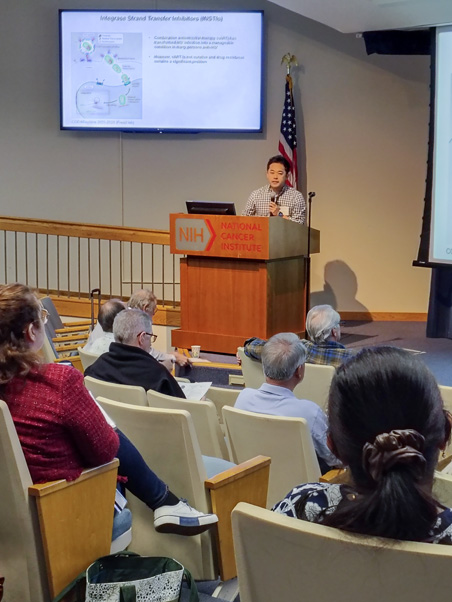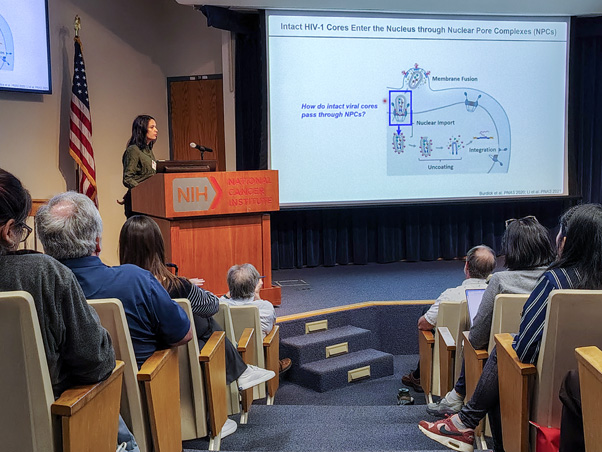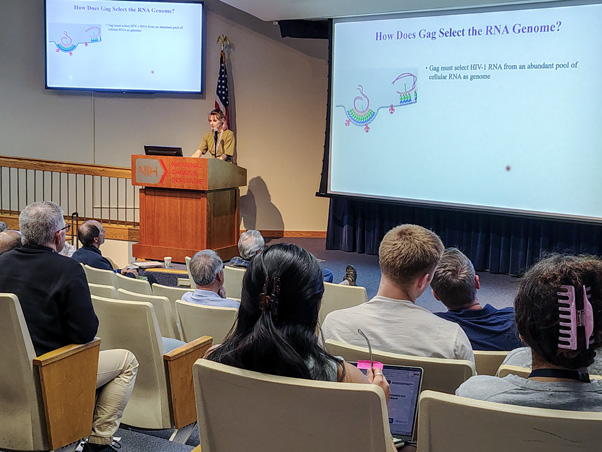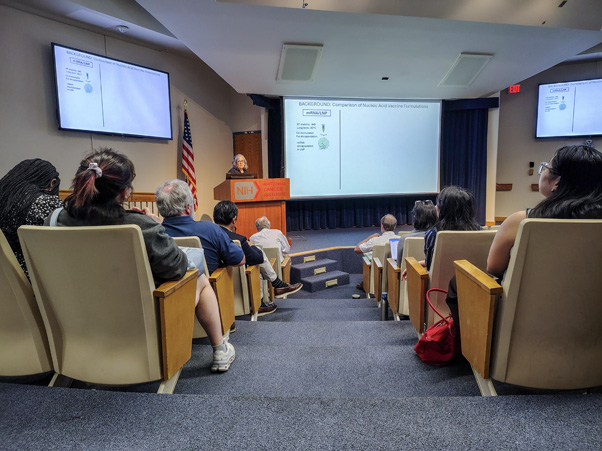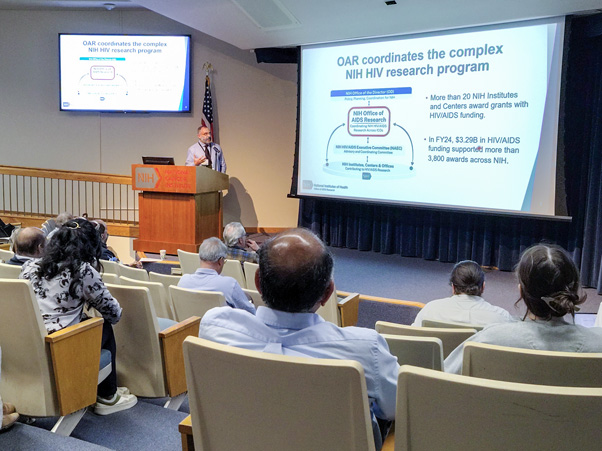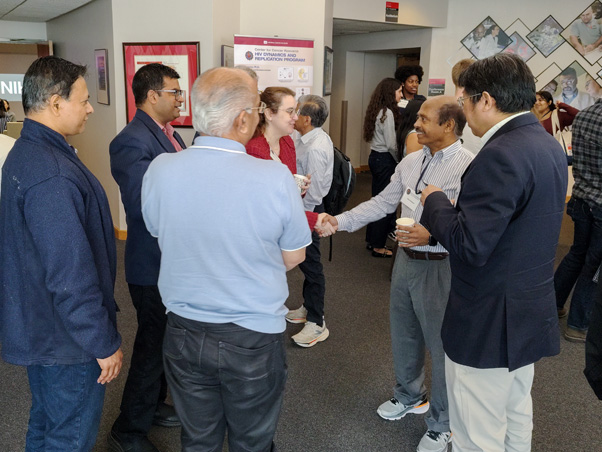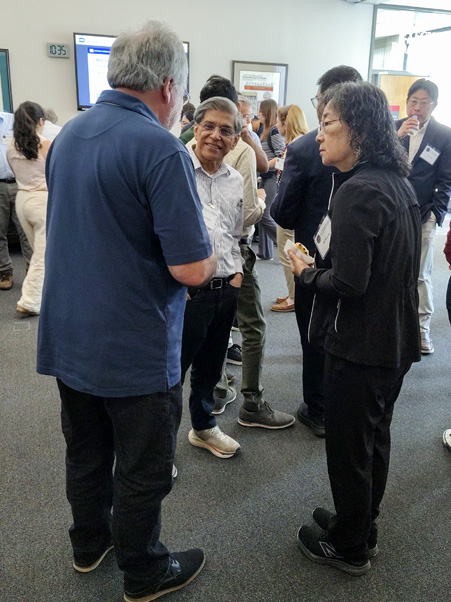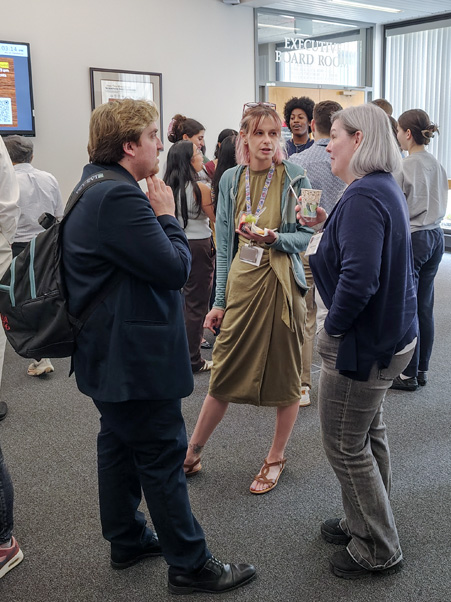



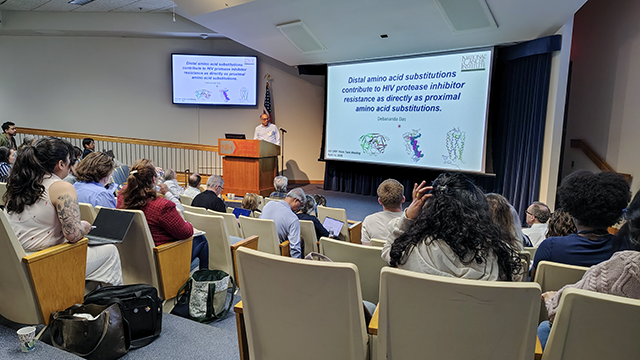
The HIV Dynamics and Replication Program’s (DRP) 28th annual Think Tank was a virologist’s field day.
Nineteen lectures spanned the symposium’s more than eight-hour itinerary. Many were given by or featured the work of postbaccalaureate and postdoctoral fellows.
For an event that drew together scientists from across NIH and external institutions, the atmosphere was collegial, intimate, and—appropriately—contemplative. Spectators asked each other thoughtful questions as much as they asked the presenters.
Lectures covered advances in vaccine research, studies of viruses’ life cycles in humans, and new insights into viral behavior. One discussed NIH policy and plans.
Meant to encourage collaboration, the Think Tank hit many of the right notes, according to some attendees.
“Understanding how other scientists approach their virus of choice can inform our studies if we pay close attention,” said attendee Rebecca Grande, Ph.D., a postdoctoral fellow in the HIV DRP. “Sometimes you just need to take a step away from your work and hear other people discuss their exciting results to feel inspired.”
Here are a few excerpts.
Hikichi and Kumari Give Outstanding Lectures
Yuta Hikichi, Ph.D., and Shushila Kumari, Ph.D., both HIV DRP visiting postdoctoral fellows, scored high marks with the scientists judging the lectures.
Both received an NCI Fellows Travel Award in recognition of their presentations. (Policy restricted eligibility for the award to NCI fellows, approximately a dozen of the 19 presenters.)
Hikichi’s presentation outlined nontraditional ways HIV-1 can become resistant to integrase strand transfer inhibitors, an antiretroviral therapy used to suppress HIV in people living with the virus. Resistance can be life-altering—even life-threatening—for these individuals.
Hikichi showed that certain mutations in the envelope, HIV’s outer coating, can increase resistance to the drugs in cell models. He suggested scientists and doctors therefore look beyond the drugs’ specific target in HIV and instead consider the whole virus when resistance arises.
Kumari shared her analyses of interactions between the HIV-1 capsid and NUP98. The capsid encapsulates HIV’s genetic material. NUP98 is one of the proteins HIV exploits to get its genetic material into a cell’s nucleus, a critical step for making more virus.
Using a fusion assay, Kumari identified the region of NUP98 that interacts with the HIV-1 capsid. She also determined that a protein, cyclophilin A, can interfere with this interaction by attaching to HIV-1. Her findings help clarify the mechanisms HIV uses to take over cells, and they improve scientists’ understanding of possible intervention methods.
Data on Three Vaccine Approaches
Three presentations discussed vaccine development efforts.
Sophia Brown, a Ph.D. student working with the NCI Basic Research Laboratory, reported on changes in the profile of vaginal microorganisms wrought by an experimental HIV vaccine and an intravaginal microbicide.
In preclinical models, vaccination alone decreased some high-risk bacteria but didn’t change the microorganism profile, Brown said. Conversely, the vaccine and microbicide together altered the profile—and, critically, administering the microbicide after vaccination actually lowered protection against viruses like HIV by disrupting the microorganism profile. These findings illuminate concerns and considerations for these approaches.
Margherita Rosati, Ph.D., scientist in the Basic Research Laboratory, shared results from preclinical studies of another experimental HIV vaccine.
The vaccine combines a type of nanoparticle, used in other experimental vaccines, with a noninfectious HIV fragment. Rosati and colleagues designed a regimen consisting of an initial dose followed by two booster doses.
Even a year and a half later, the vaccinated models had robust immune cell responses and high antiviral antibody levels.
“This is a good protocol for vaccination,” Rosati said of the regimen.
Dipa Mitra, Ph.D., postdoctoral fellow in NCI’s HIV and AIDS Malignancy Branch, presented her research on gammaherpesvirus vaccines. Gammaherpesviruses include pathogens like Epstein-Barr virus and Kaposi sarcoma herpesvirus (KSHV), which—under certain circumstances—can contribute to or cause cancer. No gammaherpesvirus vaccines have been approved for humans.
Mitra and colleagues used a mouse gammaherpesvirus 68 model to test three generations of experimental KSHV vaccines in mice. The third-generation vaccine resulted in a strong antibody and immune cell response in recipient mice, she said. The mice also experienced milder viral replication after a subsequent encounter with gammaherpesvirus 68.
Further trials will need to determine whether the vaccines protect humans.
A Satisfactory Event
In concluding the symposium, John Coffin, Ph.D., a professor at Tufts University who formerly led the HIV DRP, congratulated the speakers and audience on another successful exchange of ideas. Coffin has chaired each Think Tank since the event’s inception in 1997 and has previously expressed his appreciation for its scientific accomplishments and collaborative spirit.
This year was no different in his eyes.
“We had a great series of presentations and a great series of discussions, and that’s what it’s all about,” he said.
Samuel Lopez leads the editorial team in Scientific Publications, Graphics & Media (SPGM). He writes for newsletters; informally serves as an institutional historian; and edits scientific manuscripts, corporate documents, and sundry other written media. SPGM is the creative services department and hub for editing, illustration, graphic design, formatting, and multimedia.