

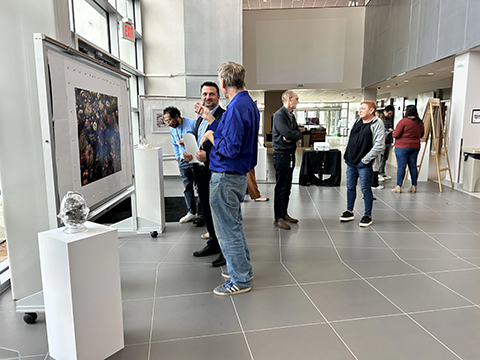
A new collaboration between the Frederick National Laboratory for Cancer Research (FNLCR) and the Frederick Arts Council recently showcased the intersection between science and art.
The Frederick Arts Council’s latest art exhibit, “Where Energy Meets Matter: Exploring the Frontiers of Science,” invited artists to explore the dynamic interplay of art and science and celebrate the cutting-edge research and innovation happening at FNLCR and throughout Frederick.
As part of the submission call, the artists were provided with images from FNLCR, the National Cancer Institute’s national laboratory, to use as inspiration. Images included Ebolavirus particles (the virus that causes Ebola) seen under a scanning electron microscope, structures of mutant genes, immunofluorescence images of skin biopsies, and three-dimensional images of mitochondria.
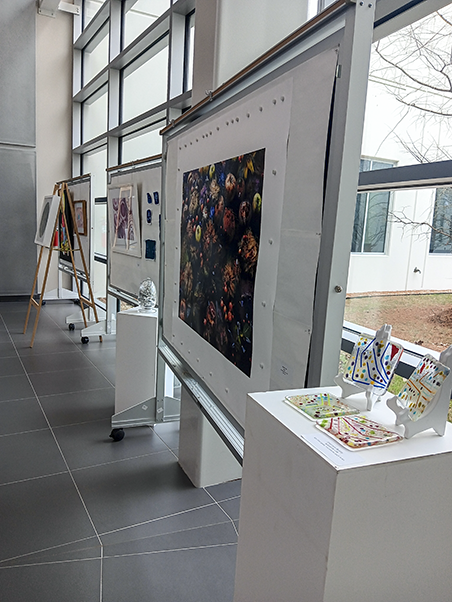
The resulting artworks made for a stunning array of paintings, sculptures, digital prints, hand embroidery, paper collages, and more.
“We are connecting world-class science with world-class art here in this room,” Louise Kennelly, executive director of the Frederick Arts Council and the leading force behind the collaboration, said of the art exhibit.
Two FNL Artists Contributed to Exhibit
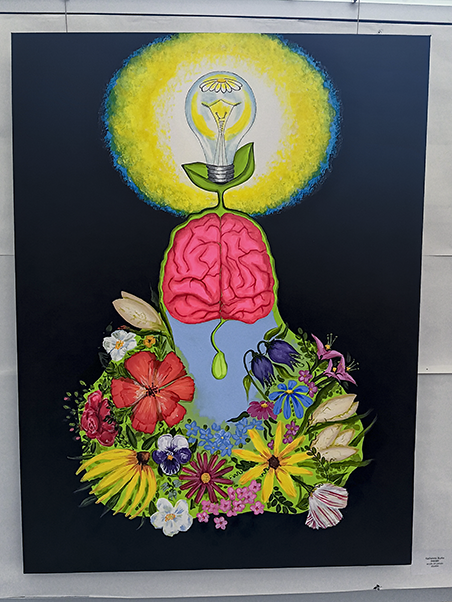
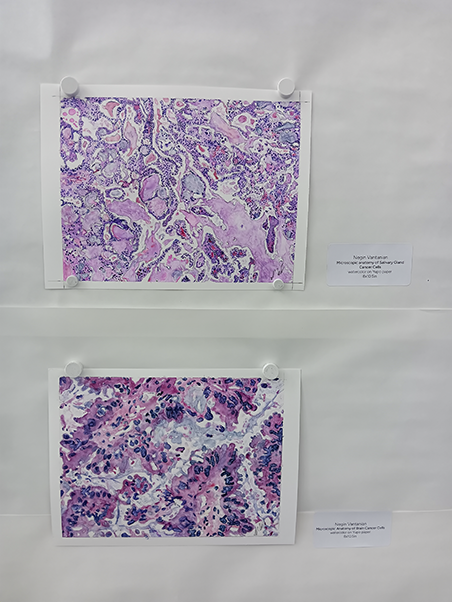
Among the many talented artists in the exhibit were two FNLCR painters: Kathryn Burke, a talent acquisition team lead in Human Resources, and Negin Vatanian, a project manager in the Clinical Research Program.
“Artists and scientists share some of the same impulses: to observe closely, to question deeply, and to follow curiosity wherever it leads,” said Burke. Her piece, a colorful acrylic painting called Theory, celebrates that shared spirit.
“Working at the Frederick National Lab, I’m continually inspired by the scientists and researchers I encounter every day—people whose curiosity drives discovery,” Burke said.
Vatanian explained that her piece—a watercolor painting called microscopic anatomy of salivary gland and brain cancer cells—was inspired by her prior job working in a pathology department where she prepared H&E slides, which are stained slides of tissue specimens used for diagnosing cancer, among other uses.
“I’ve found unexpected beauty in the patterns of cancer cells, which sparked an idea: If I could see beauty, perhaps others could too,” Vatanian said. “My vision is to use this art as a form of narrative therapy, offering patients and their families a unique lens through which to view their illness in a different light.”
Vatanian’s work speaks to the dichotomy between objective pathological analyses and the aesthetic patterns within tissues that those analyses might uncover. By capturing the elegance of such patterns in nature, even in something as frightening as cancer, her work aims to inspire courage.
A Successful Exhibit
Approximately half of the artwork was displayed at the Advanced Research Technology Facility (ATRF), where the pieces were enjoyed daily by FNLCR employees, a reminder of the importance of and beauty in their own work, even if most of that work goes unseen.
While the ATRF is not open to the public, the public was able to see the rest of the pieces at Gallery 115, located inside of the Y Arts Center (115 E. Church St., Frederick, Md.). The exhibition closed on January 21.
Victoria Brun is a partnership project manager in the Frederick National Laboratory for Cancer Research Center for Innovation and Strategic Partnerships, where she provides project management support across the office’s broad portfolio of collaborative projects. Among its functions, CISP establishes the partnerships and collaborations among Frederick National Laboratory for Cancer Research scientists and external researchers in government, academia, industry, and the nonprofit research sector.