

After an impressive 49-year career, Frederick National Laboratory for Cancer Research’s “virus whisperer” has retired.
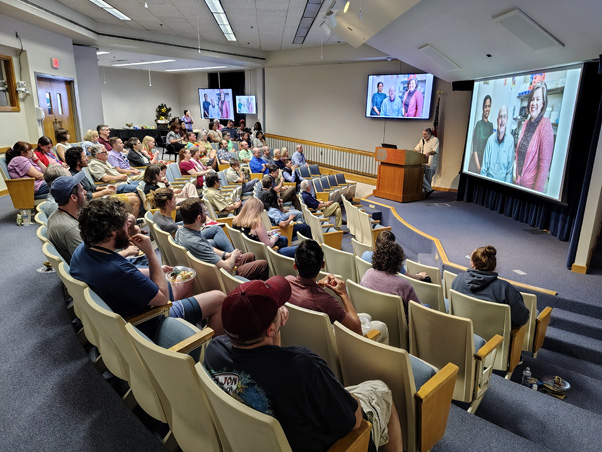
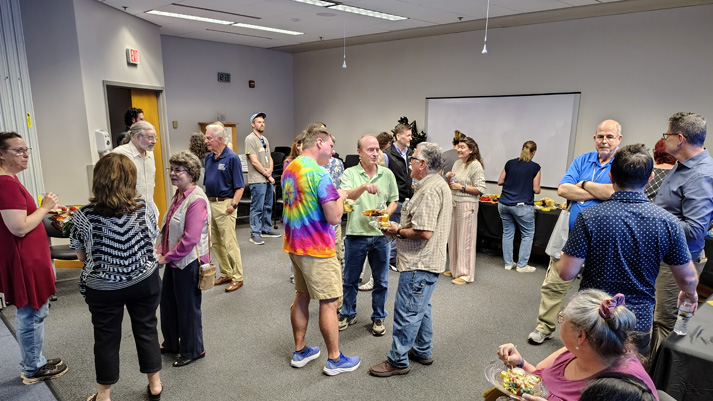
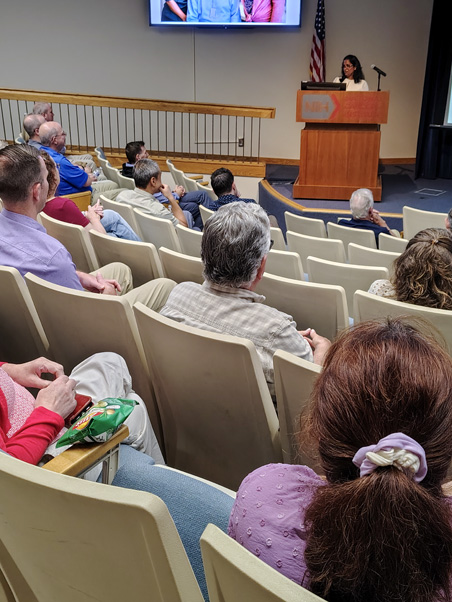
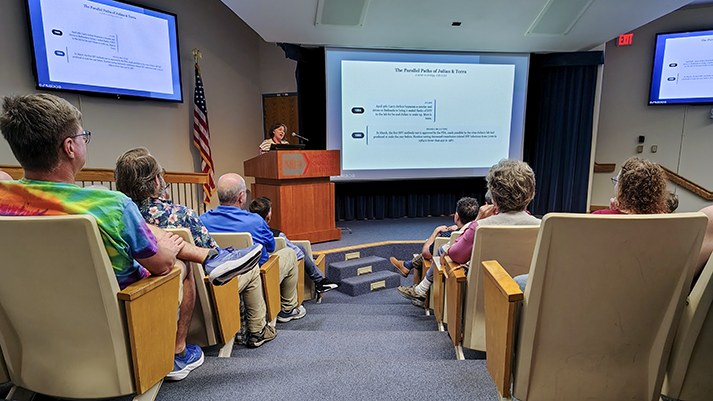
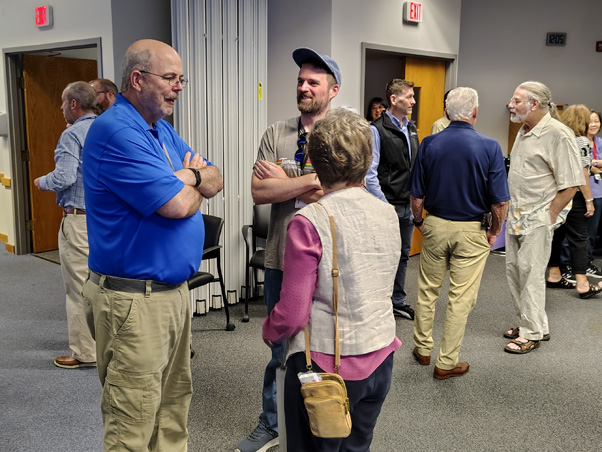
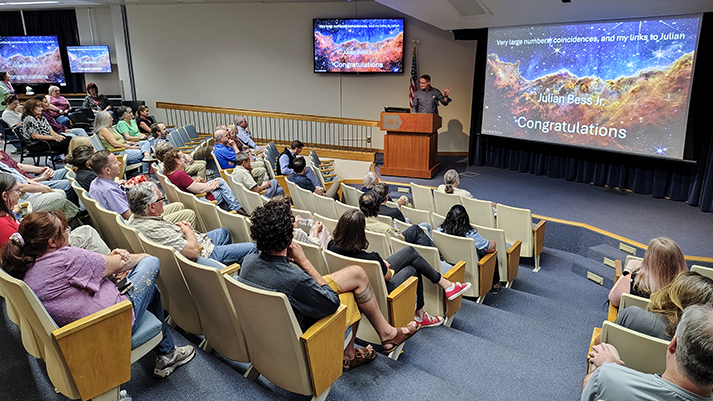
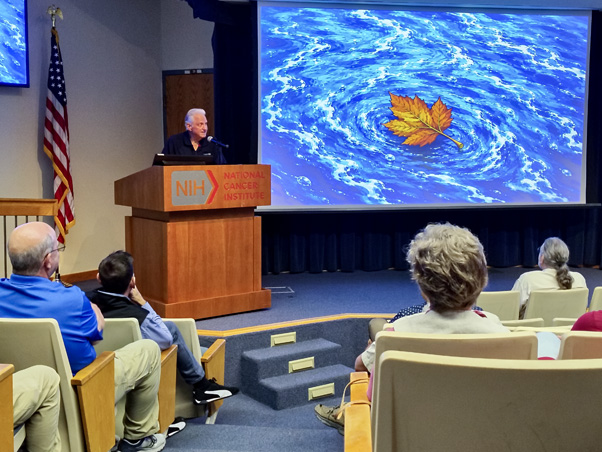
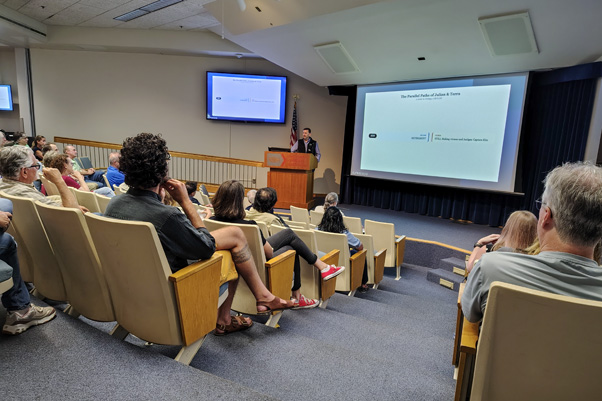
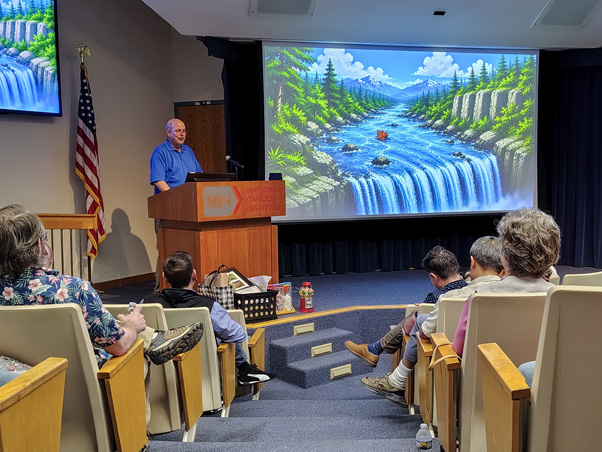
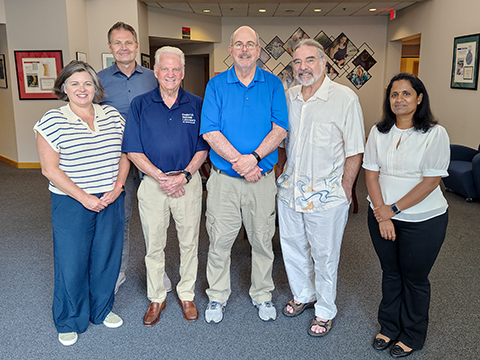
Julian Bess Jr., head of the Biological Products Core in the AIDS and Cancer Virus Program (ACVP), traded his title for an emeritus position near the end of the summer. His family, colleagues, and friends held a heartfelt seminar in Building 549 to celebrate his achievements.
“Julian is a remarkable individual, an incredible scientist, and ‘one of one,’” said Jeffrey Lifson, M.D., former director and current deputy director of ACVP.
As head of the Biological Products Core, Bess led the safe production of viral components and strains to facilitate research into HIV, certain cancers, and other diseases. ACVP used these products and shared them with laboratories around the world.
Some of them are one of a kind or were believed to be nearly impossible to create. Colleagues dubbed Bess “Lord High Keeper of the Virus” and “virus whisperer” in earnest recognition of his expertise and encyclopedic knowledge of the core’s extensive and unique inventory of AIDS viruses.
“He leaves behind a passion for science and a level of lab organization science may never see again,” said Terra Schaden-Ireland, research associate in the Biological Products Core.
History-Maker and Collaborator
Like any retiree, Bess saw many historic events transpire during his career, everything from the advent of personal computers to the invention of polymerase chain reaction (PCR).
But sometimes, he was the one making history.
He was an integral member of the Biological Products Laboratory (BPL), the team that enabled the creation of the first blood test for HIV.
In 1984, while the AIDS pandemic raged, NCI tasked BPL with producing massive quantities of virus for five companies racing to develop a way to screen the nation’s blood supply. The initiative aimed to stop the spread of HIV via transfusion.
“In just one year, they produced more virions than stars in the Milky Way galaxy,” said Brandon Keele, Ph.D., director of ACVP.
The following year saw two of the five companies receive Food and Drug Administration approval for blood tests, their research made possible by the HIV that BPL had produced.
An estimated 12,000 Americans had acquired HIV via transfusion between 1978 and 1984. With the rollout of the tests in 1985, health officials could identify HIV-containing blood products. Transfusion-related transmission soon dropped to near-zero.
“It’s incredible what [the team] accomplished,” Bess said of the viral production effort. “Only the people who did this can truly appreciate the logistical nightmare that it was. I still can’t believe it was accomplished, but it was.”
In the decades since, the blood test has been credited with preventing the spread of HIV to countless individuals, with some estimates putting the number in the millions.
Bess made other seismic contributions over the years. He and colleagues once rescued a collection of frozen tissue samples that were about to be discarded. Though they had no immediate usefulness, Bess’ team believed they might one day come in handy.
Years later, Bess and Larry Author, Ph.D., former ACVP director, sent those samples to Beatrice Hahn, M.D., Ph.D., which would eventually lead to Hahn’s pivotal work tracing the origin of the HIV responsible for the global pandemic back to specific strains of simian immunodeficiency virus in a specific community of African chimpanzees.
In another twist of fate, Keele worked on that research as a fellow in Hahn’s laboratory, authoring major studies well before he ever joined ACVP.
“Julian’s influence traveled far beyond our walls,” said Anitha Vijayagopalan, research associate in the Biological Products Core.
‘A Leaf in a Stream’
Bess has been fascinated by complex systems all his life. He recalls an early memory of being captivated upon seeing the intricate mechanisms inside a wristwatch.
“I just gotta understand how things work,” he said.
His love for science blossomed in high school, fostered by his instructors, Mr. Humbert and Ms. Barton. He pursued his passion into college, taking as many microbiology classes as he could while studying at Virginia Tech.
Bess interviewed for a position at Frederick Cancer Research Center, the first forerunner to NCI Frederick and Frederick National Laboratory for Cancer Research, in 1977, just five years after the facility was established.
He still remembers the intimidating experience. The buildings, which NCI had inherited from the Army’s former biowarfare facility, were dark, imposing, and oppressively cheerless. To top it off, he’d driven four hours for the interview, only to discover the interviewer didn’t show up.
Nevertheless, Bess accepted a position with the facility’s Viral Resources Laboratory and started not long after. He planned to stay a year or two, then find another job.
Naturally, those plans were never realized.
“Sometimes you’re like a leaf in a stream. Just go with the flow,” Bess said.
He capitalized on the facility’s proximity to nearby Hood College, becoming one of the first graduates of Hood’s new master’s program in biomedical sciences in 1981.
Bess’ first few years in Frederick offered him other opportunities, too. He briefly transferred to another laboratory to work on protein chemistry—“what I really wanted to do,” he once said—before being tapped to lead BPL’s biochemistry unit under Arthur.
Bess “was so responsive and so dedicated to what he did and the projects he undertook, I didn't need to worry about them,” said Arthur, who retired as CEO of SAIC-Frederick, the national laboratory’s previous contractor, in 2011.
“That had an effect on my continuing career,” Arthur added, saying he credits Bess for showing him he didn’t need to monitor his staff when the right people were in the right positions.
With the emergence of HIV and its identification in 1983, much of Bess’ career became dedicated to researching the virus and producing viral material.
His published studies on HIV in the 1980s and 1990s informed his future ACVP colleagues’ research while they were still training elsewhere. Both Keele and former ACVP investigator Jacob Estes, Ph.D., credit Bess’ work for enabling parts of their postdoctoral projects.
In more recent years, Bess has been a gray eminence in HIV research: never one to seek the spotlight but widely respected for his expertise and cherished for his tact and sense of humor. Colleagues from as far away as Sweden and the United Kingdom knew they could depend on him for viral products that were impossible to find elsewhere.
His attention to detail and insistence on accuracy likewise won the admiration of peers near and far.
“He notices things the human eye was not meant to detect,” Vijayagopalan said.
Acclaim and Gratitude
Bess met much of the acclaim at his retirement seminar with a dash of his usual humor.
“I’ve just been a squatter here for 50 years. Things changed around me, and I didn’t move,” he said.
Yet he also reflected with gratitude on the mentors, collaborators, and coworkers who shaped his career. In his remarks, he told their stories and thanked them by name.
A consummate mentor himself, he paused to pass the baton to Schaden-Ireland and Vijayagopalan, his coworkers in the Biological Products Core, dubbing them the new “Lords High Keeper of the Virus.”
Then, in closing, Bess jokingly declared himself “no longer ‘Lord High Keeper’ of anything.” But judging from his colleagues’ remarks, that may not be an entirely fair assessment.
He remains a keeper of priceless historical knowledge, a virtuoso of virology, and—above all—the bearer of his peers’ and loved ones’ tremendous esteem and well wishes as he begins the next chapter of his life.
Samuel Lopez leads the editorial team in Scientific Publications, Graphics & Media (SPGM). He writes for newsletters; informally serves as an institutional historian; and edits scientific manuscripts, corporate documents, and sundry other written media. SPGM is the creative services department and hub for editing, illustration, graphic design, formatting, and multimedia.