


Two scientists at different stages of their careers are driving environmentally friendly changes in their labs and inspiring others to make changes toward sustainability.
For both Ru-ching Hsia, Ph.D., principal scientist in the Electron Microscopy Core (EMC), and Thomas Abney-Lidahl, postbaccalaureate fellow in the HIV Dynamics and Replication Program, “green” practices are a top priority and personal mission guided by their experience and witnessing the benefits at other institutions.
“There are small changes we can make to help our lab run more efficiently,” Abney-Lidahl said.
In a regimented scientific environment, shaking up routine can be hard, but doing so can lead to impressive reductions in energy consumption. Laboratories consume up to 10 times more energy than office space and more energy per square foot than any other type of facility (after data centers).
“We need to change peoples’ habits,” Hsia said.
And Hsia and Abney-Lidahl have the experiences to show it’s worthwhile and easier than you might think.
Reducing Effects of Big Energy Consumers
Some of the easiest changes Hsia and Abney-Lidahl spearheaded made the biggest impact on energy consumption.
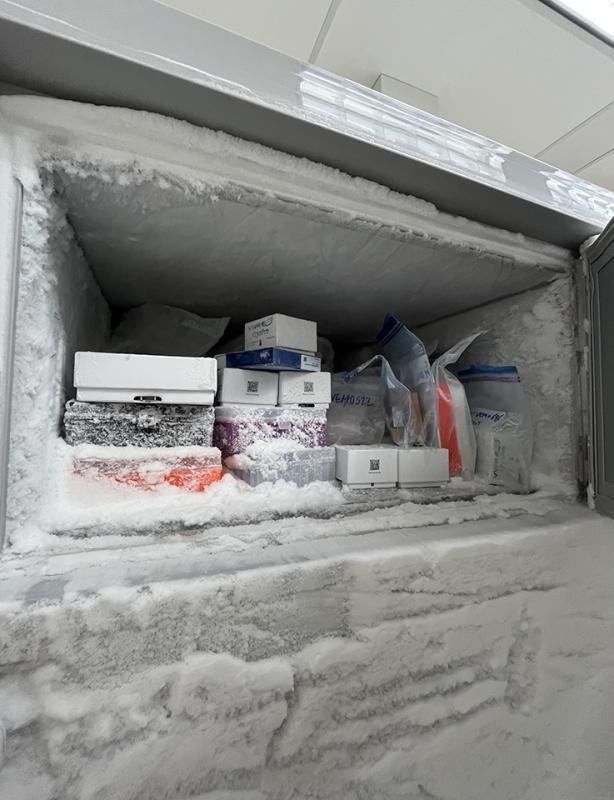
One involved raising the temperature on the ultra-low-temperature freezers both labs use to preserve materials. These freezers typically use multiple compressors and draw significant energy to maintain their extremely low temperature requirements when operating in the higher ambient room temperature common in most labs.
After reading more about the freezers, Hsia realized that, sometimes, −60–70°C is sufficient, instead of the standard −80°C. Increasing the temperature by 10–20°C can reduce the freezers’ energy consumption by up to 40%, as well as save on energy costs.
Meanwhile, Abney-Lidahl secured the support of his senior investigator support to raise the temperature on their lab’s freezers.
“Clearly it’s in everyone’s best interest to reduce energy consumption in our labs,” said Eric Freed, Ph.D., the lab head and the director of the HIV Dynamics and Replication Program.
Their laboratory manager had to change the freezers’ alarms and notifications so they wouldn’t trigger constant alerts—a simple fix. The lab has also increased frequency of preventive maintenance so the freezers run more efficiently.
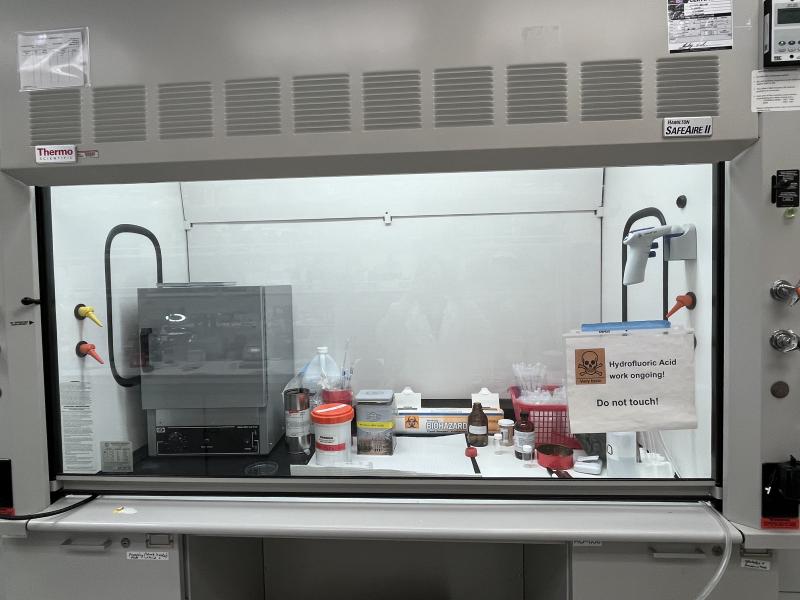
Biosafety cabinets with fume hoods are another significant source of a labs’ energy consumption. Due to safety concerns, they cannot be powered off during operating hours, but like the freezers, Hsia and Abney-Lidahl came up with creative solutions.
Hsia found closing the sashes when not in use conserves some energy. Meanwhile, Abney-Lidahl showed the advantages of Freed’s lab in powering down the least-used hood in the Biosafety Level 2 laboratory on the weekends, a less busy time. Two others in the main laboratory are shut down each night.
As an extra energy-saving step, Hsia reduced energy use of another frequently used appliance at EMC: the largest of its three ovens. They were rarely filled to capacity, so she opted to have her team alternate use of the two smaller ovens instead.
“I thought, we can start by just bringing awareness … I can only control [what’s] in my lab,” she said.
Small Habits that Make a Big Difference
Evaluating the little habits that can create greener practices was hard but yielded interesting results.
Abney-Lidahl proposed turning off the lab’s water baths and heating blocks at night. Given their importance and frequent usage, his labmates expressed concern that heating them up each morning would cause delays.
But, in true scientific fashion, another lab member collected data and found it took less than five minutes for the blocks to reheat. Once they realized how quickly this could be done, everyone agreed. Then, it was simply a matter of changing the standard operating procedures and reminding everyone to follow through. Soon, the changes became routine.
For her part, Hsia has encouraged her team to reduce the use of plastics whenever it isn’t necessary for sterility or special protocols. Now, her team uses glassware and aluminum where possible.
When plastic can’t be avoided, she asks lab members to reuse it. For example, her team saves lightly used disposable tubes to collect chemical waste for disposal, rather than opening a new one each time.
“This simple shift reduces plastic consumption without disrupting anyone’s workflow,” Hsia says.
While Hsia acknowledges that standard recycling is valuable, she has learned that plastic is never truly recycled. It is repurposed through a process that degrades it until eventually, it ends up in a landfill. That means reducing and reusing can make a greater impact than recycling alone.
Spreading the Word
Even small changes can add up, especially if the impact is multiplied across other labs.
That’s why Hsia shows others not only what is possible but also demonstrates the difference sustainability makes on lessening environmental strain.
“There are a lot of little things we can do—and I don't want people saying, ‘Oh, that makes no difference.’ If each person makes a little contribution, and you have 100 people, it adds up,” she said.
Abney-Lidahl also aims to inspire others. He plans to connect with postbacs in the HIV Dynamics and Replication Program to encourage them to implement similar changes. He’s hopeful that it will be an easy shift, and so is Freed.
“It’s worth noting that the steps we took to conserve energy were very simple to implement and required a minimal time and effort. I would encourage other labs to consider ways to conserve energy,” said Freed.
Hsia is especially insistent that talking to her colleagues—and anyone else who will listen—is what will help people to change their habits.
“The more we talk about it, I think the more people hear it. The more people hear it, [the more people] will realize, ‘Oh, this is something I can do in my lab, too,’” said Hsia. “Over time, these conversations help people recognize opportunities to reduce waste, and gradually their habits begin to shift.”
Karolina Wilk is a technical editor in SPGM, where she writes for NCI Frederick and Frederick National Laboratory’s news outlets and edits scientific manuscripts, corporate documentation, and other writing. SPGM is the creative services department and hub for editing, illustration, graphic design, formatting, and multimedia training and support.