




After a one-year pause, the NIH Summer Internship Program (SIP) is back. A cohort of students will join NCI Frederick again this summer.
Returning with an emphasis on scientific positions, the program has stirred considerable enthusiasm—and memories of past successes.
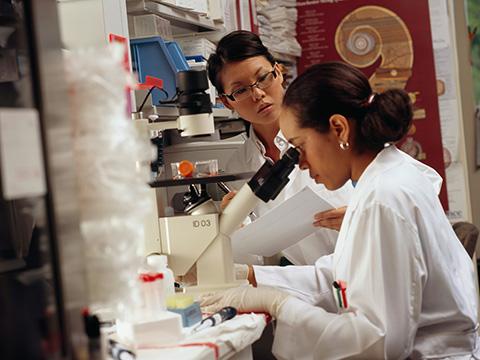
The SIP gives college and professional students eight to 10 weeks of full-time training at NIH, including NCI Frederick and Frederick National Laboratory for Cancer Research. NIH-wide, over 1,000 interns participate yearly, on average.
Staff and students alike regard the program as a priceless training opportunity.
It’s “a service that we are giving back to the community and to the future scientists, future veterinarians, future doctors, and future facility managers,” said Jatinder Gulani, D.V.M., Ph.D., a long-time mentor and the attending veterinarian for the NCI Frederick campus.
One needn’t look further than the NCI Frederick campus for examples.
SIP Gave Some Staff Their Start
Keirstin Kiley and Laura Cody had just completed their undergraduate degrees when they became interns, and they were hired to staff positions immediately after their internships ended. They say they wouldn’t be where they are today if it weren’t for the SIP.
Kiley interned with Gulani in 2016—his first intern—and subsequently joined the then-new Gnotobiotics Program. She has held a series of growing roles and responsibilities there over the last 10 years.
“I hope more incoming students are able to experience the growth the program was able to give me,” said Kiley, who’s currently a research associate and facility manager.
Gulani commends Kiley’s success. Seeing her career flourish has been joyful and gratifying, he said.
Cody was an Industrial Hygiene intern with Environment, Health, and Safety (EHS) in 2015. Her transition to her new position after her internship was seamless, she said.
“I continued working in the [Industrial Hygiene] office, at the same desk, with the same team, doing the same kind of work that I had been doing throughout the summer. The internship didn’t just prepare me for my first role, it helped me see a long-term future within the EHS field,” said Cody, who currently works on the EHS Apps Team.
These kinds of experiences are what the SIP strives for. According to NIH, the program seeks to help students explore career options, build skills, and grow professionally, with the aim of preparing them for future roles in science and related fields.
Despite Changes, Opportunities Remain
With the SIP’s focus on scientific positions this year, NCI Frederick staff are evaluating how internships formerly dedicated to support roles can be focused strongly on science, said Julia Bakhru, the program’s liaison for NCI Frederick. The goal is to ensure positions are available yet aligned with biomedical workforce developments.
“The program gives [NCI Frederick] an opportunity to continue our legacy of training the next generation of scientists, supporting mentors as they share their wealth of expertise to improve health outcomes around the world,” said Bakhru, who is also the education outreach specialist in the Frederick Office of Scientific Operations.
Mentors will continue as normal, tailoring their instruction to individual interns’ plans and ambitions. This approach combines rigor and encouragement, giving students challenging, professional-level responsibilities while creating a safety net to help them learn and excel.
“It’s just about setting people up to succeed. … Obviously, they have to walk through the door themselves and do the work, but people need to be given the opportunity to find ways to succeed,” said EHS Director Terri Bray, who facilitates her staff’s participation in the program.
Bray, who trained in a similar program at the Department of Energy early in her career, says her internships equipped her for future roles—even as she points to several current EHS employees, such as Cody, who got their start interning with NIH. Like Gulani and other mentors, she considers such opportunities foundational.
“I just appreciate the ability to have the program. I think the [internship] programs are important, and for those of us that have the time to invest in them, it’s important to do so,” she said.
Samuel Lopez leads the editorial team in Scientific Publications, Graphics & Media (SPGM). He writes for newsletters; informally serves as an institutional historian; and edits scientific manuscripts, corporate documents, and sundry other written media. SPGM is the creative services department and hub for editing, illustration, graphic design, formatting, and multimedia.