




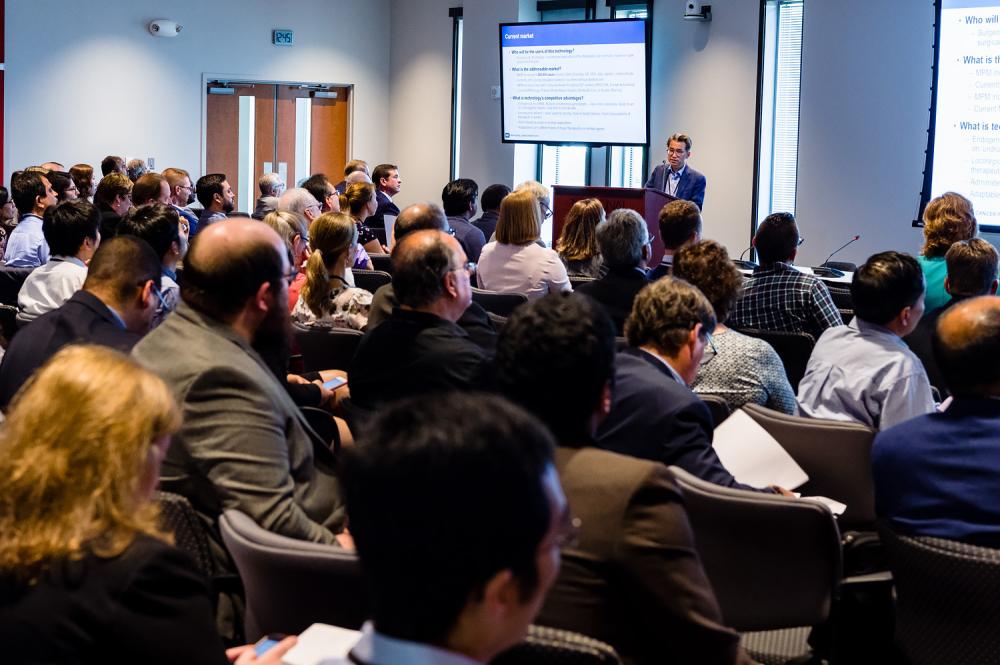
On September 9, the Technology Showcase returns to the Advanced Technology Research Facility for its ninth year. In addition to showcasing cutting-edge biomedical technologies developed at the Frederick National Laboratory for Cancer Research and National Cancer Institute, the event offers educational and networking opportunities for companies, investors, entrepreneurs, technology scouts, and other biotech stakeholders.
The Showcase will kick off at 11:30 a.m. with a networking lunch. Presentations will start at 12:30 p.m., and Jeff Allen, Ph.D., president and CEO of Friends of Cancer Research, will deliver the keynote.
There will be two panels: “Dos and Don’ts of Partnering with NCI and FNLCR” and “Moving Things Through FDA Review.” A handful of funding agencies will also give five-minute pitches with tips on how to get serious consideration.
There will be exhibit tables, networking, and one-on-one partnering opportunities via the event’s conference app, with a key focus on networking throughout the event.
“The Technology Showcase is unique to NIH—not just NCI and FNLCR—in that it is a unique assembly of the medical research community,” said Michael L. Salgaller, Ph.D., of NCI’s Technology Transfer Center. Salgaller has been a member of the planning committee since the event’s inception. “It’s a place where researchers can meet entrepreneurs and investors for potential spinouts. It’s a place where inventors and tech transfer professionals directly interact with potential collaborators and licensees.”
Available Technologies
As the name suggests, the cornerstone of the event is the great technologies available for licensing or partnership. NCI and FNLCR inventors will present each technology.
FNLCR inventor Stephen Adler, Ph.D., will present on the next-generation autoradiography device called the Quantitative Particle Identification (QPID) digital autoradiography system. The QPID system can image the radioactive dose in a tissue sample. What makes it unique is that this device can measure charge particle activity emanating from a tissue sample for individual decays. This tool could help improve radiotherapy dosing for cancer treatment.
“This technology can image radiation emissions at micron dimensions and at nanosecond time scales,” said Adler. “This breaks open a new frontier in quantitative dose measurements in tissue, critical for assessing state-of-the-art alpha- and beta-targeted radiotherapies.”
Another inventor from FNLCR, Stephen Stern, Ph.D., will present a targeted, nanoscale delivery platform for therapeutics. This platform can selectively deliver its therapeutic cargo to target cells and slowly release the active drug. The slow drug release represents an advantage over current nanomedicine platforms, which do a rapid, burst release. The platform is suitable for a wide range of applications, including cancer therapeutics and vaccines.
See the agenda for the complete list of technologies.
Other Resources
Participants will also learn how to access resources at the FNLCR and NCI, such as the Patient-Derived Models Repository and the Antibody Characterization Laboratory, both of which provide materials (patient-derived cancer models and antibody reagents, respectively) to the external research community.
A Collaborative Event
This event is part of a collaborative effort between FNLCR, NCI, Frederick County Office of Economic Development, City of Frederick Department of Economic Development, Federal Laboratory Consortium for Technology Transfer, TEDCO, and the Federal Laboratory Consortium for Technology Transfer.
The event is free, but registration is required. Registration closes after September 2.
Victoria Brun is a partnership project manager in the Frederick National Laboratory for Cancer Research Center for Innovation and Strategic Partnerships, where she provides project management support across the office’s broad portfolio of collaborative projects. Among its functions, CISP establishes the partnerships and collaborations among Frederick National Laboratory for Cancer Research scientists and external researchers in government, academia, industry, and the nonprofit research sector.