

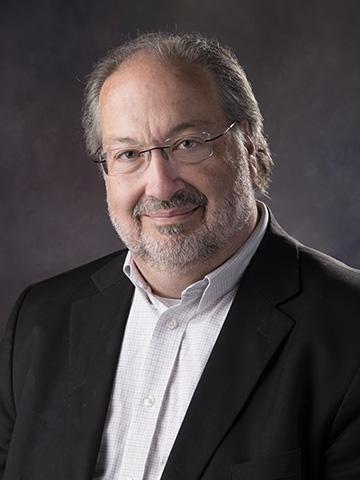
One year ago, the Poster staff and colleagues at NCI and Frederick National Laboratory for Cancer Research bid a heavy-hearted farewell to Rich Folkers, formerly the Poster senior editor and NCI Frederick communications manager. He passed away in April 2025 at the age of 65.
If he were here, he’d probably make one of his characteristically wry, witty remarks. Running his in memoriam a year on is unusual, after all, but one year has given us time to reflect on his life and legacy. Both made a difference to us.
In the final chapter of his career, Rich supported press efforts for our national laboratory and sections within NCI. He was a journalist’s journalist, passionate about telling the news—and wise about how to tell it.
Rich could review a pitch or draft, identifying concerns no one else considered, just as easily as he could churn out an article. He cautioned us not to overinterpret research advances, because an article offering patients false hope wasn’t much better than an article that’s blatantly false.
His writing rose to each occasion: always clear, direct when necessary, evocative when possible, sometimes tastefully humorous. His photos were equally energetic.
“He was an excellent writer and editor, intent on delivering complex, scientific information about cancer in a way that was accessible and engaging to both the research community and the general public and patients,” said Nancy Siebert Murphy, NCI communications director and Rich’s former supervisor.
A Cherished Mentor
Rich was gracious in sharing his insight with colleagues. Sometimes he’d serve his feedback with a dash of his signature deadpan sense of humor. He delivered jokes quietly, often with a disarming frankness that only made them more amusing.
Over the years, he guided countless writers to become better. In addition to mentoring several interns, he aided in reviewing most of the Poster articles published from the mid-2010s onward. Many of us on the editorial board have a portfolio of stories marked with Rich’s edits and suggestions.
“Rich was a phenomenal mentor of us lay writers, editors, and student interns. He had a profound effect on our own engagements with communication for which, of course, he had great talent and extensive experience,” said Walter Hubert, Ph.D., Poster senior editor and scientific program director in the NCI Frederick Office of Scientific Operations.
Rich kept a steadfast composure in what can be a stressful field. The thoughtfulness with which he approached challenges helped NCI Frederick through difficult communications. He was kind and genial, too. Behind his quips and “get the job done” philosophy, there was a genuine compassion for the people he worked with and the cancer patients his work served.
“Every so often, you get lucky enough to work with someone who becomes a friend. I am lucky to be able to say that Rich was one of those people. He was a fantastic mentor, dependable, caring, and just all around a fabulous person,” said Melissa Porter, former executive editor of Poster, who currently works at the NCI Center for Strategic Scientific Initiatives.
A Pillar of the Community
Of course, Rich was much more than a journalist. In his many familial and community commitments outside of work, he championed other causes with as much fervor as he had for telling the news.
He volunteered with Kids in Need Distributors (KIND), a nonprofit founded by his friend, Jeremy Lichtenstein, using his journalistic and photographic expertise to support the organization. KIND supplied food on weekends to Montgomery County children who qualify for free or reduced lunches—often from low-income families.
The organization reached 28 schools and delivered over 1.9 million meals, according to the Montgomery County Volunteer Center. KIND merged with Manna Food Center in December 2024, according to a post on KIND’s Facebook page.
Rich particularly valued the humane treatment of animals and was involved in Animal Rescue Corps, a nonprofit that rescues animals from post-disaster, abusive, and neglectful environments and offers education to animal shelters and the public.
He participated in several missions to rescue puppies from inhumane conditions. He and his friend Scotlund Haisley, founder of Animal Rescue Corps, published a book recounting their experiences: Compassion in Action: My Life Rescuing Abused and Neglected Animals.
Rich and his family fostered many dogs over the years. After the COVID-19 pandemic shifted our operations to remote work, some of their canine wards would make “guest appearances” at the Poster board meetings via Rich’s screen. Rich’s affection for them and his concern for their individual needs were always evident.
A Lifelong Passion
Rich fell in love with photography at a young age. His father, a U.S. Air Force chaplain and hobbyist photographer, maintained a darkroom in the house. Rich was allowed to use it to practice and indulge his budding passion for the medium.
“I kind of … followed his footsteps that way,” Rich said in a 1994 interview with C-SPAN.
Once in high school, Rich became a self-described “news media junkie” and got interested in journalism. The Folkers family had settled in Silver Spring, Maryland, when Rich’s father retired, and their proximity to the nation’s capital meant there was always a breaking story to follow. Rich even attended some of the Watergate trials while he was still a student.
Pairing his love for photography with his love for the news, Rich obtained a photojournalism degree from the Syracuse University Newhouse School of Communications in 1981.
He went to work for the Associated Press that same year. Years later, he’d call the job the “toughest training” of his career: a demanding environment that moved at a breakneck pace.
This was Rich’s trial by fire in photojournalism. He succeeded and went on to join the U.S. News and World Report in 1985, where he’d remain for 20 years, eventually becoming associate photo editor and, later, director of media relations.
While there, he managed the photos that appeared in the magazine—and on the cover. He authored articles on Bill Gates’ Lake Washington mansion, the death of the Grateful Dead’s Jerry Garcia, the changing technologies that filled the 1990s, and many other topics. After becoming director, he fielded questions from reporters at other news outlets. Rich was an immensely skilled communicator.
“We’re all branches of the same journalism tree, and if you want to work in the visual medium, you still ought to know how to write a lead, how to research a story, and how to use all the same journalistic techniques anyone would,” he said in 1994, advice just as much as an explanation of his own path.
Rich joined the NCI communications office in 2005. By 2007, he had become its head and was steering the press policy, handling media inquiries, and preparing communications on behalf of then-NCI Director John Niederhuber, M.D.
Rich shifted to a role focused on NCI Frederick in the mid-2010s and soon became involved in the Poster newsletter. He made an indelible impact on his coworkers here.
He took interest in NCI Frederick’s history and championed the “Echoes from the Past” series of articles, which we’re still publishing. He also led efforts to compose the motto for the Frederick Office of Scientific Operations. The words hang on a sign in Building 427’s foyer.
He’s greatly missed, but some of his wisdom abides with those of us he mentored over the years. We’re grateful to have known him and worked with him, and we appreciate and strive to apply all his lessons.
A clip of one Rich’s photos can be found via the Washington Commanders’ archive (image 62/68). Another is posted on WTOP News (image 7/11). Links to and mentions of organizations, outlets, and commercial products in this article do not imply endorsement by the U.S. government.
Samuel Lopez leads the editorial team in Scientific Publications, Graphics & Media (SPGM). He writes for newsletters; informally serves as an institutional historian; and edits scientific manuscripts, corporate documents, and sundry other written media. SPGM is the creative services department and hub for editing, illustration, graphic design, formatting, and multimedia.