


Editor’s note: This is the second installment in our series recognizing the legacy of the NCI Frederick Scientific Library and is part of a miniseries about the library’s history.
(Updated May 21.) This article has been updated to correct an error in the original May 6 posting. That version incorrectly stated that WISCO took over library operations in 1984, instead of 2001.
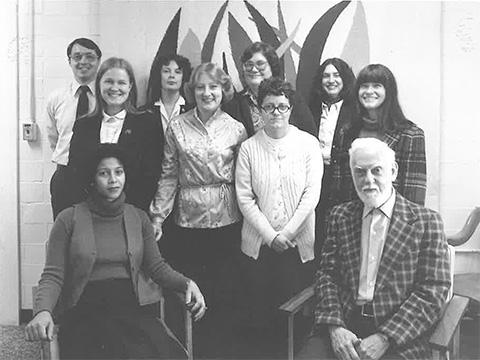
The Scientific Library employees at NCI’s Frederick Cancer Research Center (FCRC) repeated history in 1972, perhaps without realizing it.
Much like the librarians who opened the Camp Detrick Technical Library in 1943, they were among the first staff to begin working at the epicenter of what would soon become an important scientific facility.
And like in the early days of Camp Detrick, the Scientific Library—both the physical and spiritual successor to the Technical Library—rapidly became a hub for information and technology during the FCRC’s first years.
Its small team operated out of Building 426 as part of the FCRC’s new Technical Information Center, which offered abundant resources. Records from those years testify to the comprehensiveness of the collection the library inherited from the U.S. Army.
Roughly 14,000 books and 4,700 volumes of periodicals occupied the shelves, materials not only in English but also French, German, Polish, and Russian. A special collection featured 2,800 articles translated into English from other languages. There was also a microfilm collection containing 4,175 volumes.
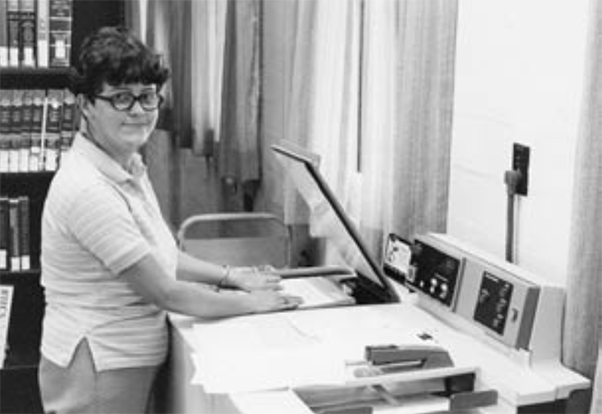
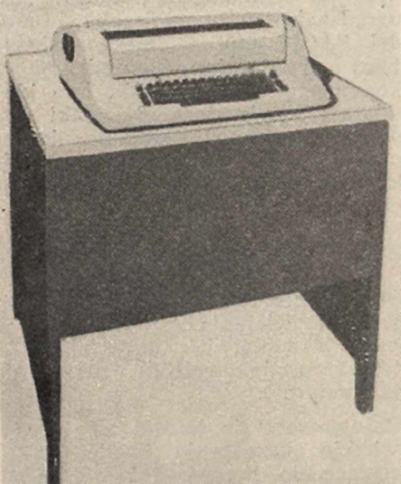
Library patrons could use Xerox copiers, an IBM 2741 terminal that let them access certain unpublished materials, and the MEDLINE database that contained a bibliography of periodicals available at the National Library of Medicine in Bethesda. It was all cutting-edge for its time.
The library staff added to the collection, too, with new items arriving near-daily. Throughout the 1970s, the Scientific Library subscribed to hundreds of scientific journals, anywhere from 380 to more than 600 at various times.
‘Keep Us on Your Mailing List’
Adhering to President Richard Nixon’s plan for the FCRC to be open to the world, the Scientific Library started forming relationships with other libraries and taking a place among its counterparts. In May 1973, the library distributed its first monthly accession list—an inventory of items in its collection—to more than 100 other scientific libraries. In the pre-Internet era, it was an important way to share information about the materials available for interlibrary loan.
“We hope that it will prove to be a useful resource to you, and we invite you to send any material of a similar nature to us,” wrote Karen Patrias, the first Scientific Library director, in a letter that introduced the library and accompanied the list.
Later records show that no less than 150 libraries asked to continue receiving the list. At least one, the Institute for Cancer Research in Philadelphia (part of Fox Chase Cancer Center today), wrote to say as much, returning Patrias’ letter with a note scrawled in green ink at the bottom.
“Please keep us on your mailing list,” it said.
A Jewel of the Community
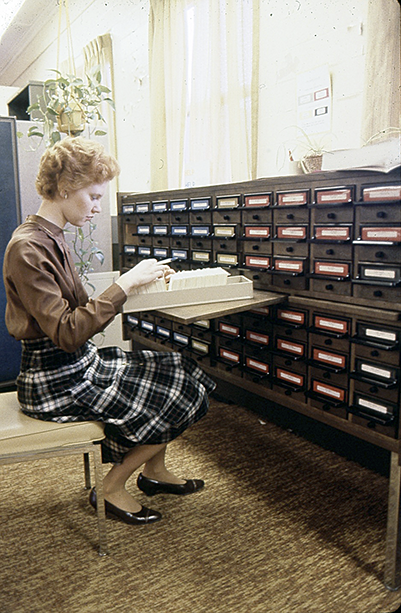
Over the coming years, the library staff labored to keep pace with the latter 20th century’s rapid changes in technology. In 1979, they initiated a project to retire the old card catalog and replace it with a machine-readable alternative, although, due to technological factors, it’d take them until October 31, 1994, to complete.
Other changes happened faster. In 1982, the Scientific Library joined OCLC, an international cooperative of libraries, to handle its interlibrary loan transactions. Just seven years later, on June 25, 1989, the library’s interlibrary loan team received a milestone award for being the library that submitted the 15 millionth loan request in the world through OCLC.
The year 1982 marked another milestone for the library: the beginning of its tenure as an independent contractor to NCI. Under the new arrangement, the library was operated by Data Management Services, Inc. (Data Management Services would later go on to operate Computer & Statistical Services at NCI Frederick, a position they still hold.)
Under the contract, Sue Wilson took the reins as the new library director in 1984. She would remain in various senior roles until 2019, steering the library to the cutting edge of technology and helping to establish a professional association for librarians who serve government-owned laboratories, an organization that still exists.
Wilson was already well-acquainted with the Scientific Library, too. She’d worked there as an assistant during the 1970s before departing to establish her own company, Wilson Information Services Corporation (WISCO). (WISCO would take over the library's operations in September 2001.)
Led by Wilson, the Scientific Library’s growing technological connectedness in the 1980s dovetailed with its staff’s strong relationship with NCI Frederick. Their expertise and the library’s resources enjoyed steady, high demand. For instance, their photocopying and document delivery service was so popular that the library had to limit patrons to seven requests per day.
To accommodate even more patrons, in the summer of 1986, the library’s hours of operation were extended into the evening. The longer hours also allowed the library aides to reshelve more materials and complete the document delivery and interlibrary loan requests that couldn’t be handled during the day due to the high volume of work.
An indirect indicator of the Scientific Library’s value came that same summer, when it relocated from Building 426 to the new Building 549—to a modern space that’d been specially designed for it. The library would remain there until its closure in 2025.
Few may have known it at the time, but that move marked the start of another chapter in the library’s history, a period defined by even greater evolution and service.
Samuel Lopez leads the editorial team in Scientific Publications, Graphics & Media (SPGM). He writes for newsletters; informally serves as an institutional historian; and edits scientific manuscripts, corporate documents, and sundry other written media. SPGM is the creative services department and hub for editing, illustration, graphic design, formatting, and multimedia.
Read other parts of the series: