




Editor’s note: This is the first installment in our series recognizing the legacy of the NCI Frederick Scientific Library and is part of a miniseries about the library’s history.
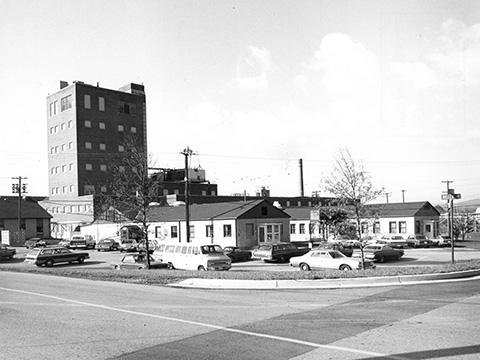
While World War II raged, engineers and tradespeople built up a little airport that’d sat humbly on the outskirts of Frederick since 1929, transforming it into a microbiological research facility. The site, renamed “Camp Detrick,” was to be the home of the new U.S. Army Biowarfare Research Laboratories.
This is where the story of the NCI Frederick Scientific Library truly begins. In 1943, a library opened its doors to scientists and staff as one of the first offices established at Detrick.
Over the next three decades, the Technical Library at Camp Detrick (and, subsequently, Fort Detrick) became a trove of books and periodicals spanning the spectrum of medical and biological sciences. Its collection included over 600 periodical titles, among them a series of the esteemed Lancet reaching back to volume one, published in 1823.
However, in 1969, President Richard Nixon directed the U.S. government to cease its biowarfare research, a decision that seemed initially to jeopardize the Technical Library’s impressive collection. If the biowarfare laboratories at Detrick were to close, what would become of their library?
Nixon offered something of an answer in October 1971, when he announced that the labs, still shutting down at that time, would be turned into a world-class cancer research center under the National Cancer Institute.
Cancer Institute Desires Collection
Within four days of Nixon’s announcement, NCI officials sent the Department of Defense an itemized list of the cancer institute’s desired buildings at Detrick. (They had already been discussing a potential transfer of buildings with the Army.) The document flagged the Technical Library building “for immediate NCI occupancy” and ownership.
So keen was NCI’s interest in the library that its officials mentioned the building multiple times during their lengthy negotiations with the Department of Defense. Frank Rauscher, Ph.D., then NCI director of etiology, even noted NCI’s desire in a January 1972 letter to an assistant secretary of the Army.
Yet NCI didn’t intend to hoard the collection. As plans were laid for the new cancer research center, other federal agencies also established or moved research groups dedicated to biodefense and medical countermeasures onto other parcels of Fort Detrick’s land. NCI assured the Army that the library, if placed under NCI’s ownership, “would be open to all.”
Within the Army, the remaining library staff hurried to prepare for the handoff to NCI, performing a final inventory of all materials in the library and on loan. To expedite the process, the librarians didn’t even ask employees to return the loaned materials for inventory. Rather, they circulated lists to the various departments and asked the recipients to confirm that they had the listed items.
“This will not be a complex job for us, but it will be time-consuming, and we are short-staffed, and time is short,” wrote E. Paul “Mack” Magaha Jr., acting chief of the office overseeing the library, in the May 12, 1972, memorandum that accompanied the lists.
Recipients were given just three weeks to reply. Their laboratories were to close at the end of June, with NCI’s research center to open around the same time.
Under New Ownership
On June 23, NCI announced that Litton Bionetics, Inc., would operate this new facility, the Frederick Cancer Research Center (a forerunner to NCI Frederick and Frederick National Laboratory for Cancer Research), and on June 26, the first cadre of 15 Litton employees got to work.
The staff grew throughout 1972 and initiated several of the center’s first tasks and departments. This included the Technical Information Center, which encompassed both the former Detrick library and a service for editing, illustration, and photography.
Fort Detrick’s library had—to all appearances—seamlessly passed into NCI’s hands. Its resources would no longer be used for war with other humans but rather “the War on Cancer.”
The significance of this wasn’t lost on the library’s new owners. A 1970s booklet detailing the cancer center’s departments called the Technical Information Center “one of the most important assets the FCRC inherited from the Army’s biological defense research program.”
It’s doubtful anyone at the time knew the truth those words would carry decades into the future. The library would be the only one NCI ever got, and for the next 53 years, it would remain a vital resource for NCI’s Frederick operations and for researchers around the world.
Samuel Lopez leads the editorial team in Scientific Publications, Graphics & Media (SPGM). He writes for newsletters; informally serves as an institutional historian; and edits scientific manuscripts, corporate documents, and sundry other written media. SPGM is the creative services department and hub for editing, illustration, graphic design, formatting, and multimedia.
Read other parts of the series: