




Editor’s note: This is the final installment in our series recognizing the legacy of the NCI Frederick Scientific Library. Lisa Simpson contributed reporting to this article.
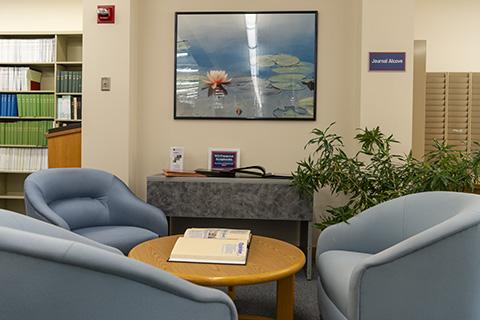
The August sun slanted through the Scientific Library’s windows, casting the remnants of the general collection in a warm glow. Cloistered in private rooms and seated at secluded desks and carrels, scientists studied in monastic silence.
But it wasn’t business as usual. Empty shelves gaped amid intervals of books. People perused rows of hardback volumes marked “For Adoption.” In one of the technology rooms, a National Park Service ranger, equipped with a few tools, wrestled a metal bookshelf that refused to be disassembled.
And there was a sense of urgency. The library would cease operations in barely two weeks. Its five remaining librarians were seeking new homes for its thousands of books, scientific journals, and other taxpayer-funded federal property rather than seeing them warehoused or recycled.
The undertaking was one of the last crucial tasks in the Scientific Library’s dutiful history.
“We’ve really been very thoughtful of how we want to leave the library in the space when we all walk out the door,” said Deanna West, the library’s director.
Some of the items had been in the collection since 1943, when the U.S. Army opened a library at Camp Detrick, the predecessor to Fort Detrick and the land NCI Frederick occupies.
Scientists and staff from across NCI Frederick and Frederick National Laboratory for Cancer Research seized the chance to save some of the much-loved collection. For weeks, they’d been coming to adopt items.
“I will be writing up a ton of transfer memos because labs have come and taken just entire journal collections, like 100-and-some volumes of journals, back to their labs, and that’s great,” West said.
NCI Frederick’s federal property policies allow items to be transferred to other staff, different governmental agencies, and academic organizations provided there’s proper documentation, meaning employees could claim some of the library’s resources with little hassle.
This was also why a park ranger was disassembling shelves and hauling them out to a van in the parking lot. Through the transfer procedures, the librarians connected with colleagues across the government whose teams could likewise use the library’s materials.
Ceded with Care
Library technician Pam Noble’s office testified to the care the librarians had put into their task. All around the room, objects awaited transport to other repositories.
Files about the library were going to the C. Burr Artz Public Library across town. Boxes of historical documents were to be sent to the National Institutes of Health Office of History. A shelf of aged books, among them the original Camp Detrick library inventory list, didn’t yet have a destination, but Noble was hopeful.
Six boxes had already gone to the National Institutes of Health. Later, she’d take another 20 to the National Library of Medicine.
“It’s been my goal, since I knew that we were either downsizing or closing, to assemble a lot of the archival material and, again, the journals and get them to somewhere they will be preserved or they’ll be used,” Noble said, calling the progress “very satisfying.”
A History of Responsible Sharing
This wasn’t the first time the Scientific Library had pared its collection. The librarians began hosting “adoption weeks” late in 2024 as part of their transition to the “Library Without Walls” online-only operating model. The first such weeks saw more than 150 people rehome media and supplies.
Even before that, the librarians had transferred books and journals to other libraries as electronic versions became available through the Scientific Library’s subscriptions.
Working with a retired Department of Agriculture librarian, they once shipped journals to Native American tribal libraries. Another time, they sent more than 1,100 boxes of books and journals to a nearby university that agreed to take custody, a transfer so unexpectedly massive that Noble jokes it probably got her blacklisted with the university’s librarians.
This spirit of sharing characterized the Scientific Library’s long history at NCI Frederick, even in the librarians’ final efforts to entrust their charge to others.
Now, at institutions around the U.S. and on the shelves of NCI Frederick laboratories, the Scientific Library abides, in a way. Its resources, for 53 years stewarded by its staff, continue to serve the public good.
Its legacy is in good hands.
Samuel Lopez leads the editorial team in Scientific Publications, Graphics & Media (SPGM). He writes for newsletters; informally serves as an institutional historian; and edits scientific manuscripts, corporate documents, and sundry other written media. SPGM is the creative services department and hub for editing, illustration, graphic design, formatting, and multimedia.
Read other parts of the series:
- Echoes from the Past: Life and Times of a Scientific Library, Part 1 (miniseries part one)
- Echoes from the Past: Life and Times of a Scientific Library, Part 2 (miniseries part two)
- Echoes from the Past: Life and Times of a Scientific Library, Part 3 (miniseries part three)
- Scientific Library Defined by Experiences, Its Staff Say